

Ever watched rain pour over your gutter like a waterfall and wondered what it is doing to your foundation?
You do not want to pay for a whole new system if a few hangers and a bead of sealant would do the trick. You also do not want to pay for a patch that fails again next spring. This is a common worry, and it deserves a straight answer.
At Valley Roofing & Exteriors, we have spent more than 20 years repairing, replacing, and inspecting gutters across the Shenandoah Valley and Central Virginia. We hear this exact question at almost every gutter appointment.
This article is for homeowners who see a gutter problem and want an honest call on repair versus replacement. By the end, you will know the warning signs, how long each material really lasts here, and what drives price.
Why Do Gutters in the Shenandoah Valley Wear Out Faster?
Gutters here work hard. Four local factors push them past their limits.
- Freeze and thaw. In Harrisonburg, January averages a high of 42°F and a low of 22°F (WHSV Weather). Water trapped in a clogged gutter freezes at night, thaws by afternoon, and freezes again. That cycle adds weight and works fasteners loose.
- Big trees and busy downspouts. It takes only a handful of leaves to plug a downspout. Older neighborhoods full of oaks and maples fill gutters fast. Maple “helicopter” seeds even like to sit on top of gutter guards. Still, a guarded gutter beats an open one every time. Learn more about our gutter guards.
- Summer downpours. Short, heavy thunderstorms can swamp a 5-inch gutter on a large roof.
- Historic homes. Older homes in Staunton, Harrisonburg, Lexington, and Charlottesville often have half-round, copper, or built-in box gutters. When a home sits in a historic district, we follow what the district requires, and we are set up to do that work.
Not sure which style you have? See our guide to types of gutter designs.
What Gutter Problems Can Be Repaired?
If the trouble sits in one spot and the rest of the system drains well, repair is usually the smart money.
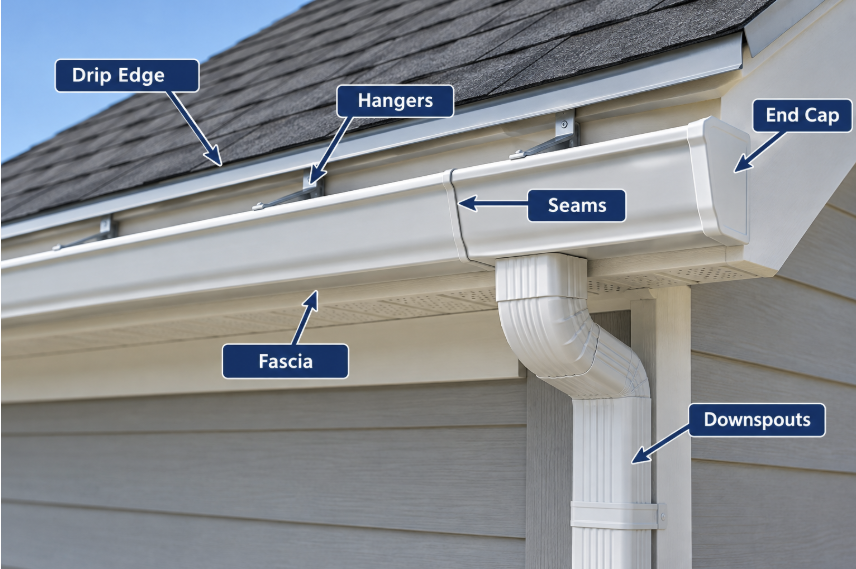
Small Leaks at Seams and End Caps
A drip at a joint usually means the sealant has failed. Cleaning and resealing the joint often stops it. Watch the mitered corners, though. If a corner has already been cleaned and resealed once, a second leak is usually our signal to replace.
Loose or Missing Hangers
Hangers hold the gutter to the fascia board. Here is a sneaky one: from above, the hanger looks fine, but the screw behind it has snapped off at the fascia. Once three or four in a row break, the gutter starts to pull away. Caught early, this is a simple repair.
Minor Sagging in One Section
Sagging usually means too few hangers. That is the most common mistake we see from other installers and do-it-yourself repairs. We space hangers every 16 inches on 6-inch gutters and every 24 inches on 5-inch gutters. Under a metal roof, we tighten 5-inch gutters to every 16 inches.
Clogged or Disconnected Downspouts
Downspout clogs often hide inside, where you cannot see them. Flushing the line and reconnecting loose sections usually solves it.
| Problem | What You See | Repair or Replace? | Why |
|---|---|---|---|
| Leaking seam or end cap | Drips at a joint | Repair | Fresh sealant usually stops it |
| Mitered corner leaking after a reseal | Drips return at the corner | Replace | A second failure means the joint is worn out |
| Loose hanger | Gutter pulling away in one spot | Repair | New hanger and screw into solid fascia |
| One sagging section | Dip where water pools | Repair (usually) | Add hangers at proper spacing |
| Clogged downspout | Overflow, even in light rain | Repair | Clear and flush the line |
| Spike-and-ferrule hangers | Nail heads across the gutter face | Replace | Older design; every nail is a hole |
| Rust holes in many spots | Orange stains, pinholes | Adds complexity and waste | Corrosion keeps spreading on steel |
| Rotted fascia behind gutter | Soft wood, peeling paint | Replace gutter and fix fascia | The gutter has nothing solid to hold |
What Warning Signs Signal I Need to Replace My Gutters?
When problems run through the whole system instead of one spot, repairs become a treadmill. On every gutter call, we check three things first: the hanger system, whether the gutter has pulled away from the fascia, and the overall condition. A quick look tells us a lot.
Our firmest rule: we do not repair a spike-and-ferrule system. This older style was common 40 to 60 years ago. A long nail runs through the face of the gutter, through a metal sleeve (the ferrule) that keeps the gutter from collapsing, and into the fascia. Every nail is a hole, and those nails loosen over time. Today, we use hidden hangers that clip inside the gutter and screw into the fascia.
Other signs that point toward replacement:
- Rust, cracks, or holes along long stretches
- A seam or corner that has been resealed and is leaking again
- Gutters pulling away along the whole run, not just one spot
- Soft fascia boards or water stains on siding
- Pooling water or washed-out soil near the foundation
- 5-inch gutters that overflow on a large or steep roof
Seeing several of these at once? A free inspection can sort it out. You can also learn the most common gutter installation shortcuts that cause early failure.
How Long Do Gutters Last in Virginia?
In our experience, well-installed seamless aluminum gutters last about 40 years here, and copper can last a century. Material sets the ceiling according to the International Association of Certified Home Inspectors. Installation and drainage decide whether you ever reach it.
| Material | What We See in the Valley | InterNACHI Estimate | Notes |
|---|---|---|---|
| Aluminum (seamless) | About 40 years | 20 to 40+ years | Most common choice; rust-resistant |
| Galvanized steel | About 20 years, if it drains properly | 20 years | Standing water speeds up rust |
| Copper | About 100 years | 50+ years (100 for copper downspouts) | Often found on historic homes |
Age alone is not the deciding factor. A 15-year-old system with snapped screws and too few hangers can be in worse shape than a 30-year-old system that was hung right. Condition beats the calendar.

Cost Drivers: Repair v Replacement
A repair costs a fraction of a new system up front. But a cheap repair that fails in five years can cost more than a new system that lasts for decades.
| Factor | Repair | Full Replacement |
|---|---|---|
| What drives the price | Number of problem spots, roof height, access | Linear feet, stories, roofline, material, downspouts, guards, drainage fixes |
| Long-term value | Strong when damage is isolated, and the system is fairly new | Resets the clock for decades with aluminum or copper |
What pushes a quote higher? Second-story work, complex rooflines with dormers and valleys, copper or half-round gutters, fascia or soffit repair, gutter guards, and drainage corrections like downspout extensions or underground drains. For full ranges by home type, see our gutter pricing guide. Comparing quotes? Read why our price may run higher than a low bid.
Should I Replace My Gutters When I Replace My Roof?
We highly recommend it. If your gutters are near the end, replace them with the roof. The real risk is timing.
Picture this. You put up new gutters this year, then replace the roof two years later. Your gutters are still shiny and straight. Then old shingles, tools, and debris slide off the roof, right across them. Roof work is rough on gutters, and scratches and dents are likely.
Doing both together means one plan, one crew schedule, and a drip edge and gutter that fit each other from day one.
Frequently Asked Questions About Gutter Repair and Replacement
Can I repair my gutters myself?
Some small fixes are fine for a handy homeowner, like clearing a clogged downspout or resealing one leaky seam. The risk is the ladder and the details. The most common do-it-yourself mistake we see is spacing hangers too far apart, which leads to sagging. We space hangers every 16 inches on 6-inch gutters and every 24 inches on 5-inch gutters. For second-story work, rotted fascia, or anything beyond one or two spots, call a pro.
Does homeowners insurance cover gutter repair or replacement?
Sometimes. Insurance may cover gutter damage from a covered event, like wind, hail, a falling tree, or a storm. It typically does not cover normal wear and tear or age. Check your policy and take photos of any storm damage right away.
Should I add gutter guards when I replace my gutters?
For most homes with trees nearby, yes. A guarded gutter beats an open one every time. Guards are not maintenance-free. Small debris, like maple helicopter seeds, can still sit on top and need an occasional check. Adding guards during a replacement is the easiest time to do it. See our gutter guards page and gutter pricing guide for options and costs.
Should I choose 5-inch or 6-inch gutters?
The difference is how much water they carry. A 5-inch gutter works for smaller homes and simple rooflines. A 6-inch gutter is the better fit for larger roofs, steep pitches, and roofs with valleys that funnel water to one spot. If your current 5-inch gutters overflow during summer downpours, size may be the real problem.
What warranty comes with new gutters?
Seamless gutters are formed on-site from coil, so there is no separate gutter brand warranty. The material warranty comes from the metal coil supplier. What protects you day-to-day is the installer’s workmanship guarantee. Before you sign, ask any contractor what their workmanship warranty covers and for how long.
Is It Time to Fix or Replace Your Gutters?
Small, isolated problems are usually repairable. A leaky seam, one loose hanger, or a clogged downspout should not cost you a whole new system. Widespread rust, rotted fascia, spike-and-ferrule hangers, and repeat repairs in the same spots point toward replacement.
Timing matters right now. Every fall, leaves fill gutters across the Valley, and winter freeze-thaw is right behind it. Weak gutters rarely survive both. Fixing problems before winter protects your foundation, fascia, and flowerbeds.

Want to see what a clean, well-pitched gutter system looks like? Browse our gutter project gallery.
Not sure which one your home needs? We will give you an honest answer, even if that answer is a simple repair. Schedule a discovery call with one of our project consultants.
Contact Us for a Free Estimate.
Click here to add your own text