
By Anson Martin
Why does a quote from Valley Roofing & Exteriors often land higher than the other bids sitting on your kitchen table? Potential customers sometimes tell us that we are the most expensive, so we wanted to give them a fair and honest answer. Once we take the time to explain the gap, it is rarely a mystery.
It usually comes down to what is left out of the lower estimate, not what is added to ours.
Our 22 years in the industry have taught us exactly where corners get cut and what a roof needs to actually last. That experience is why homeowners across the Shenandoah Valley treat us as the authority on getting a roof right the first time.
The Shortcuts You Never See
Roofing is a trade full of decisions that a homeowner will never actually witness once the job is finished and the crew has packed up. That is exactly why it can also be a trade full of shortcuts. A company trying to win a bid on price alone might cut corners in ways that stay invisible until years later:
-
- Reusing the existing chimney flashing instead of replacing it.
- Skipping the ice and water shield, the leak barrier that runs along the bottom edge of the roof.
- Covering up roof decking that has gone soft or slightly rotten, rather than replacing it.
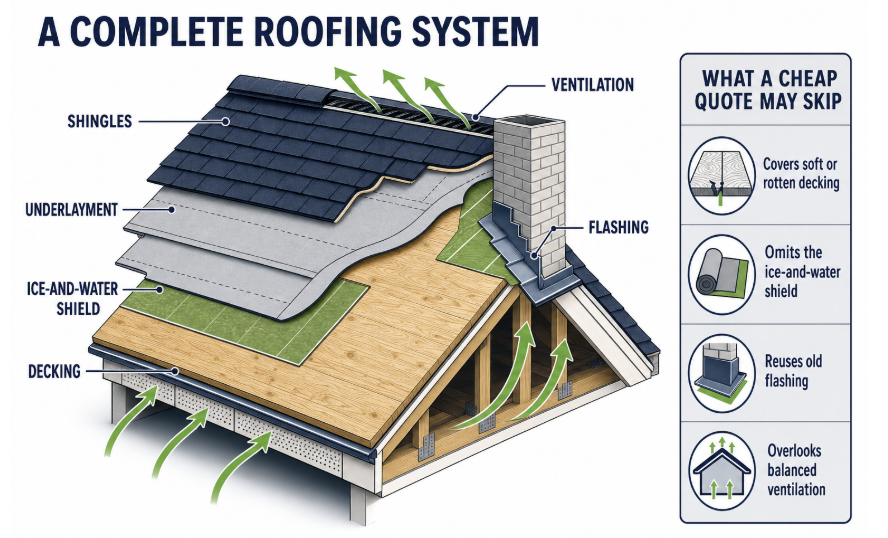
Our approach starts from a different place. If a homeowner is investing in a brand new roof, every layer underneath it needs to be right, because otherwise the finished product is not worth what was paid for it. A beautiful new roof over a compromised deck or reused flashing is not a good roof. It just looks like that for a short while.
| What Valley Roofing & Exteriors Provides | What Cheap Options Skip |
|---|---|
| New chimney flashing on every job | Reuse existing flashing to save cost |
| Ice and water shield leak barrier installed | Skip the leak barrier entirely |
| Replace soft or rotten roof decking | Cover up compromised decking |
| Trained, experienced crews who do the job right the first time | Crews with no real training, hired only to move fast |
| A staff built for long-term support, so homeowners know who to call in ten years | No intention of being in business a decade from now |
| Compliance expertise for historic homes and districts | Risk of being shut down mid-project for ignoring guidelines |
| Honest estimates based only on what can be seen, with change orders explained clearly | Padded prices or surprise costs with no explanation |
| Trained salespeople plus AccuLynx and Hover for precise, data-backed pricing | A number picked by feel, with no way to know if it is accurate |
| Proper insurance and licensing, verifiable on request | Operate without either, hoping nobody checks |
| 22 years of track record and reputation in the Shenandoah Valley | Fly-by-night operations that can vanish mid-job |
The single biggest factor that separates a cheaper quote from ours is the quality of the labor behind it. It is not difficult to find people willing to tear a roof off and nail shingles down, whether or not they actually know what they are doing. What is difficult to find, and what costs more, is the level of detail and experience it takes to do the job correctly every time. That expertise is not free, but it is worth every bit of the difference in the long run.
Why the People Matter
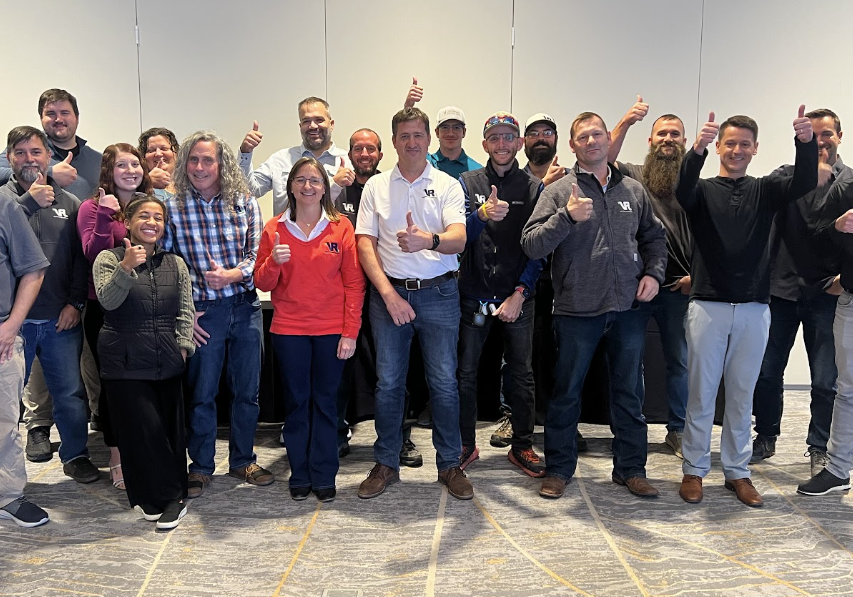
There is another piece of the cost that homeowners rarely think to ask about: the staff supporting the job long after the crew leaves the driveway. We have invested in a strong staff who keep projects flowing and communicate effectively from start to finish. Valley Roofing & Exteriors has built a company designed to be around for the long term. If an issue comes up with a roof ten years from now, a homeowner knows exactly who to call and how.
That is not true everywhere in this industry. Many contractors, whether they are in roofing, gutters, siding, or another exterior trade, are doing the job right now, with no intention of being in business a decade later. Naturally, their bids come in lower, because they are not pricing in the cost of sticking around.
Pricing Historic Homes Honestly
The Shenandoah Valley has no shortage of historic homes, and some of them sit inside historic districts with strict rules about what can and cannot be done to them. Contractors who ignore those guidelines risk being shut down mid-project and forced to start over.
Historic homes are also simply special buildings. They are full of character and detail, both inside and out, and that is part of what makes them worth preserving carefully. The challenge shows up in the maintenance details. Replacing a section of roof decking is straightforward; a trip to the hardware store solves that problem. Matching a piece of cornice trim that has not been manufactured in decades is a different story entirely. It might mean tracking down a specialty shop, having a sample matched and custom made, then painting it to blend in properly.
Because so much about an older home stays hidden until the work is underway, we only price what we can actually see at the time of the estimate. We would rather give an honest, accurate number up front than inflate a price just to protect ourselves from the unknown. If something is uncovered once the project starts that requires a change order, we explain clearly why it is needed and what it will cost. That approach is fair to the homeowner, who is not paying for padding they may never need, and it is fair to us, since we are not taking on more risk than we can reasonably absorb.
Where the Money Goes
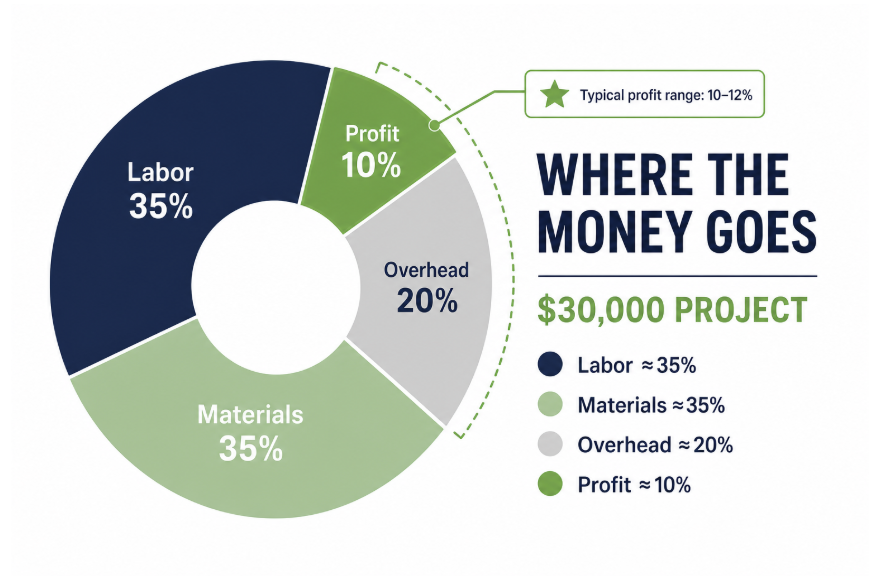
On a typical thirty thousand dollar roof, the cost breaks down roughly into thirds: about a third for labor, a third for materials, and the remaining third covering overhead and profit combined. Overhead for a company like ours typically runs around twenty percent, which leaves somewhere between ten and twelve percent as actual profit. Those figures shift a little from company to company, but that split holds up as a solid general rule across the industry.
What Separates a Real Estimate From a Guess
A thorough, accurate quote takes real time to put together, and a lot of companies simply are not willing to invest that time. We have invested in:
- Trained salespeople who know exactly what to look for and how to price it.
- Estimating software, AccuLynx, that calculates accurate pricing rather than relying on a gut feeling.
- Hover, a measurement technology that helps ensure every dimension on a job is precise.
Without those tools, a contractor is often just looking at a roof and picking a number that feels about right, with no real way of knowing whether that number is too low or too high. Our sales team, by contrast, is intentional about covering every detail so the price reflects the actual job in front of them.
What Every Homeowner Should Check Before Hiring Anyone
A few final things matter regardless of which contractor a homeowner is considering. Proper insurance and licensing should be a given, yet plenty of companies operate without either, so it is worth confirming directly.
Roofing consistently ranks among the top categories of complaints tracked by the Better Business Bureau, which says something important about this industry as a whole. Checking references and asking around matters enormously, because there have been real cases in this region of a crew starting a job, leaving it half finished, and simply disappearing with no way for the homeowner to track them down.
In the end, a roofing project comes down to people far more than materials. The right crew, the right estimating process, and a company built to last are what separate a fair price from a cheap one, and what determine whether a homeowner is happy with the outcome years after the shingles go on.

If you are not yet convinced, view our gallery and read our blog articles to further educate yourself. Then, fill out this form to talk to one of our professionals about your home project.