
By Anson Martin
Is a metal roof the newest thing on the block, or the same tough top your grandfather nailed onto your barn? If you have driven the back roads of the Shenandoah Valley your whole life, you have passed silver-topped farmhouses and barns that have weathered decades of snow and sun. So when a salesperson calls metal “the latest thing,” something does not quite add up.
At Valley Roofing & Exteriors, with more than 20 years of protecting homes across Central Virginia and the Shenandoah Valley, we have installed, repaired, and torn off enough metal to see the whole story clearly. We are not here to hand you a sales pitch. Instead, we will walk you through the real history of tin and metal roofing, explain why it took such deep root right here, and give you honest answers to the worries that have followed metal roofs for a century. If you are a Valley homeowner weighing a roof that could outlive your mortgage, this one is for you.
Where Did Metal Roofing Originate?
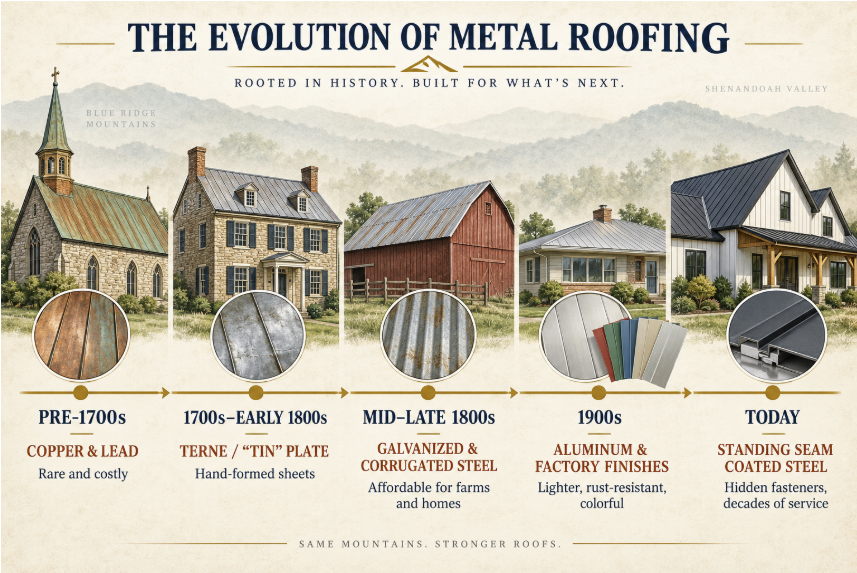
Metal on rooftops is not new. Centuries ago, copper and lead covered churches, mansions, and public buildings in Europe and Colonial America, though cost kept them rare. The real shift came in the 1700s and 1800s, when rolled iron and “tin” plate finally put metal within reach of ordinary homes and towns.
Most “tin roofs” were never pure tin. What people called tin was usually thin iron or steel coated in a tin-lead alloy, a material known as terne. Back then, roofers formed and fastened those sheets by hand, banging and bending the metal against a steel edge to lock it together, almost like shaping a giant tin can. The nickname stuck. By the mid-1800s, galvanizing (a protective zinc coating) and mass-rolled corrugated sheets made metal cheap, shippable, and long-lasting. For a deeper look at historic roofing materials, the National Park Service is a trustworthy source.
Why Did So Many Shenandoah Valley Homes and Barns Get Metal Roofs?
Metal is woven into the identity of our region, and three forces put it here.
Historic homes and districts. The Valley is full of 19th-century farmhouses, folk Victorians, and homes inside National Register districts in Staunton, Lexington, Winchester, and Harrisonburg. Standing seam metal was the roof of choice, and historic guidelines still favor it in many places. Put a standing-seam roof on an old farmhouse, and it looks like it belongs there.
Agricultural heritage. Barns and outbuildings needed a roof that shed rain and snow, resisted sparks and fire, and lasted for generations on a farmer’s budget. A hundred years ago, shingles were an inferior product and slate was expensive, so metal became the most enduring, economical option. People grew used to metal on the barn, and it was a short step to metal on the house.
Weather that tests a roof. Valley homes face heavy snow and ice in winter, hail and thunderstorms in summer, and big temperature swings all year long. Metal sheds snow, handles hail better than many materials, and does not rot. That is why a metal roof here is not a trend. It is a regional tradition that modern materials have improved upon.
What Is the Difference Between an Old Tin Roof and a Modern Metal Roof?
Here is the reassuring part. The roofs you admire on old homes are the ancestors of what we install today. Same idea, far better engineering.
The biggest upgrades live in the metal, the coatings, and the details. Old sheets were hand-formed and held down with exposed nails. Modern standing-seam and snap-lock systems hide most fasteners, so you are not depending on thousands of exposed screws and rubber washers to keep water out. Old terne was hand-painted and needed repainting; today’s panels arrive with a baked-on factory finish that holds its color for decades. Panels now run through rollers that bend them cleanly and seamers that lock them tight, instead of a mallet swung against a steel iron. And we do not want to rely on caulk to make a roof waterproof. The metal details themselves should do the work.
Then versus now:
| Feature | Old tin/terne roof | Modern metal roof |
|---|---|---|
| Core material | Iron/steel with tin-lead coat | Coated steel, aluminum, zinc, copper |
| Fasteners | Exposed nails, soldered seams | Hidden clips (standing seam) |
| Finish | Hand-painted, repaint often | Baked-on, decades of color |
| Typical life | Long, with upkeep | 50-plus years, low upkeep |
| Upkeep | Regular repainting | Occasional inspection |
If you are already sold and want to know price ranges, our roof replacement pricing guide breaks it down.

Do Metal Roofs Rust, Roar, or Attract Lightning?
These three misconceptions come straight out of the old days, and each one has a clear answer.
Rust. Old galvanized metal could start rusting in about 15 years, which is why owners repainted it again and again. Today’s coated steel and paint systems resist corrosion for decades. Yes, all metal will oxidize eventually, but that day is so far off that it is not worth losing sleep over.
Noise. The “rain on a tin roof” memory came from bare metal laid over open rafters in homes with little or no insulation. A modern home is a different species. Between you and the rain sit the panel, the underlayment, the roof decking, a well-insulated attic, and the ceiling. Most homeowners can barely hear it. In fact, we have met customers who wanted the sound and walked away disappointed.
Lightning. Metal does not attract lightning, and we tell customers never to base a roofing decision on that fear. Better still, metal is non-combustible, which can be a safety plus. For more myth-busting, read this Metal Roofing Alliance article.
Myth versus reality:
| The myth | Where it came from | The reality today |
|---|---|---|
| “Metal rusts” | Bare, unpainted steel | Coated steel and finishes resist corrosion for decades |
| “It is too loud” | Metal over open rafters | Decking, underlayment, and insulation quiet it down |
| “It draws lightning” | Barn folklore | It does not, and it is fire-resistant |
Is a Metal Roof Worth It for a Valley Home Today?
A metal roof is not a gamble. It is a proven Valley standard, now engineered to last longer and look better than the tin roofs that inspired it. Depending on the system, the environment, the installation, and the upkeep, a quality standing-seam roof generally lasts 40 to 70 years, and plenty of older ones have gone well beyond that. It is not maintenance-free, because nothing on the outside of your home is. Plan to inspect flashings, penetrations, snow guards, and the finish from time to time.
Please do not think of metal as simply a pricier shingle. They are two different decisions. A good architectural shingle roof can be an excellent choice, and metal is not right for everybody. But if you plan to stay in your home for a long time and longevity is your priority, metal deserves a serious look. Read more about switching from shingle to metal roofing. We do not have to guess whether it lasts in the Shenandoah Valley. We can drive around and point at roofs that have already proved it for generations.
One last truth from the field: the straight run of a roof is easy, and almost any crew can lay panels there. The craftsmanship shows in the details, in how the valleys, chimneys, dormers, snow guards, and flashings are handled. That is where a roof either lasts a lifetime or fails early, and it is where our experience earns its keep.

Want to see what quality metal work looks like on real Valley homes? Take a few minutes to browse our project gallery. When you are ready to talk specifics, book a discovery call or meet with a Valley Roofing & Exteriors project consultant, and we will help you choose the right metal system for your home.