
By Alan Martin
Have you ever paid good money for a new deck, only to watch it fade, stain, or scorch your bare feet by the second summer?
You are not alone. You walk into the store, and every board says “composite.” Many people simply call the whole category of deck boards “Trex” after the brand name. But composite is not one product. It is a family of boards with different cores, shells, shapes, and price tags, and the wrong pick is a mistake you may live with for 25 years or more.
At Valley Roofing & Exteriors, with more than 20 years of building and replacing decks across the Shenandoah Valley and Central Virginia, we have this conversation every week. About half the homeowners we meet start by asking about “Trex boards” before anyone has explained what composite actually means.
This guide is for homeowners ready to move past wood and who want to choose with confidence. We break down every type of composite deck board, how each one handles Valley weather, which brands our crews actually install, and relative cost. We built this guide so you could learn from the best in the business before you spend a penny.
What Is a Composite Deck Board, and How Is It Different From Wood?
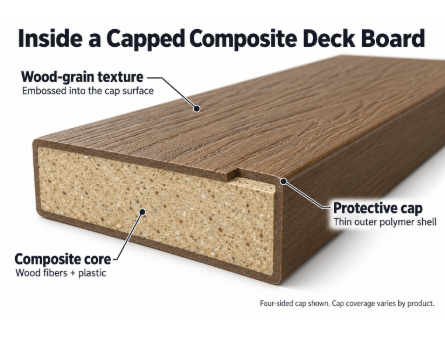
A composite deck board is made in a factory, not cut from a tree. The core is a blend of wood fibers and plastic that is mixed and pressed into a board. Most boards today are then wrapped in a tough plastic shell called a cap, which carries the color and the wood-grain look.
Pressure-treated wood costs less up front, but it needs stain, it splinters, and it rots. It also gets slick. The most slippery deck board we see is a wood board with a thin film of algae on it. We have never had a slip complaint on a composite deck, except on ice, and ice is slippery on anything.
| Feature | Pressure-Treated Wood | Composite | PVC |
|---|---|---|---|
| Relative upfront cost | $ | to $ | $ to $$ |
| Upkeep | Stain or seal every 2–3 years | Occasional cleaning | Very low |
| Typical lifespan | 12–20 years | 25–35 years | 30–50+ years |
| Feel underfoot | Can splinter and turn slick | Grippy texture, runs cooler than PVC | Grippy texture, runs hottest |
Want the full material side-by-side? Read our composite vs. PVC vs. wood decking comparison or explore our deck services.
Why Does the Shenandoah Valley Climate Change Which Deck Board You Should Pick?
Our Valley does not do mild. We get sticky summers, strong afternoon sun, hard freezes, and real snow on mountain lots. Each one stresses a deck differently.
Heat is the complaint we hear most. A dark board in full July sun can be too hot for bare feet. Humidity feeds mildew on shady decks. And many Valley homes are older, so a new deck has to look right beside a historic porch or match boards already on the house.
| Valley condition | The Risk | What to Look For |
|---|---|---|
| Summer sun and heat | Hot, faded boards | Composite over PVC, lighter colors, cooling technology |
| Humidity and shade | Mildew, slick surfaces | Capped boards with textured finish |
| Freeze-thaw swings | Shifting boards and fasteners | Hidden clip systems, careful installation |
| Snow and moisture | Rot in wood parts | Capped boards, composite framing option |
| Older or historic homes | Deck clashes with the house | Wide color range, matching existing boards |
What Are the Main Types of Composite Deck Boards?
Capped Composite
This is the modern standard and the board we install most. A wood-and-plastic core sits inside a protective plastic cap. Interestingly, most PVC boards are capped too, so the surface of a capped composite and a PVC board look and feel very similar.
Uncapped Composite
These first-generation boards have no shell, so you see the raw fibers. They were common 10 to 20 years ago. We have not installed one in about a decade, and they are hard to find today. If you have an uncapped deck that needs repair, an exact match is unlikely. We get as close as we can.
PVC (Capped Polymer) Decking
No wood at all, just plastic. It is the most moisture-proof option and usually the priciest. Our favorites are Wolf and TimberTech PVC, with warranties reaching 50 years.
| Type | Core | Capped? | Heat Underfoot | Relative Cost | Typical Warranty | Best For |
|---|---|---|---|---|---|---|
| Capped composite | Wood fiber + plastic | Yes | Cooler than PVC | to $$ | 25–50 years | Most Valley homes |
| Uncapped composite | Wood fiber + plastic | No | Moderate | Rarely | Varies | Existing legacy decks |
| PVC | All plastic | Yes | Hottest | $ to $$ | Up to 50 years | Maximum longevity |
See examples from Trex and TimberTech AZEK.
Solid or Hollow, Grooved or Square-Edge: What Do These Choices Actually Change?
Solid, Grooved-Back, or Hollow Boards
Hold all three side by side and the solid board is clearly the beefiest. You pay a premium because you are buying more material. We rarely install hollow boards, but we install plenty of grooved-back boards, which have channels on the underside. They cost less, keep the whole deck lighter, and still carry 25-to-30-year warranties.
| Profile | Best Use | Trade-Off |
|---|---|---|
| Solid | Maximum strength and feel | Heaviest and priciest |
| Grooved-back | Most home decks, best value | Slightly less material |
| Hollow | Tight budgets | We rarely recommend it |
Grooved vs. Square-Edge Boards
Grooved boards have a slot along each side for hidden clips, so no screw heads show. We use them on about 90% of our decks. Square-edge boards are screwed through the face. We often use both on one deck: grooved boards in the main field, square-edge boards around the border so you never see a groove at the edge.
One heads-up: if we are converting an old wood deck and keeping its frame, that frame may not be square. Hidden clips do not forgive that so the last board might need an angled cut. Face screws hide it better.
| Edge Type | Best Use | Trade-Off |
|---|---|---|
| Grooved (hidden clips) | Main deck surface, new frames | Needs a square frame |
| Square-edge (face screws) | Borders, older out-of-square frames | Screw heads visible |
Which Composite Decking Brands Do the Pros Actually Trust?
Our go-to board is Fiberon Good Life Weekender. It looks and performs much like Trex Select, the mid-grade Trex line, but costs closer to Trex Enhance, the entry line. That is simply better value.
We still install plenty of Trex when homeowners love the brand, want a specific color, or need to match an existing deck. Trex’s premium boards, however, cost about as much as Wolf or TimberTech PVC, and at that price, we usually point people to PVC and its longer warranty. We install TimberTech composite when a homeowner has researched and wants it.
What About Boards That Stay Cool?
Composite runs cooler than PVC because the wood fibers do not hold heat like solid plastic. Some lines go further. MoistureShield says its CoolDeck technology cuts heat absorption by as much as 35% versus standard capped composite, and Owens Corning points heat-sensitive buyers toward WearDeck, which is fiberglass-reinforced plastic with no wood. Trex also offers cooling boards in its premium line. Nearly all cooling boards come in lighter colors.

| Brand | Line We See Most | Known For | Best Fit |
|---|---|---|---|
| Fiberon | Good Life Weekender | Mid-grade quality, entry-level price | Most budgets |
| Trex | Enhance, Select, premium | Name recognition, color range | Brand fans, color matching |
| TimberTech | Composite and PVC | Broad product range | Homeowners who researched it |
| MoistureShield / Owens Corning | Cooling lines | Cooler surface | Full-sun decks |
What Does a Composite Deck Warranty Actually Cover?
Two things: materials and labor. Manufacturers cover the boards for 25 years on the low end and 50 on the high end, and within any brand, the cheaper board carries the shorter warranty. Fiberon backs its Weekender boards for 25 years against performance problems, stains, and fading. Pressure-treated wood has no product warranty at all.
We add a five-year workmanship warranty on every deck, so your composite deck is essentially fully covered for five years. Claims are rare. Once, a Fiberon order showed up in two noticeably different shades. The manufacturer paid for new boards and our labor to replace them. Coverage is up to the manufacturer, but we have never had a reasonable claim denied.
Want zero wood anywhere? We can also build with composite framing. It costs more, but it brings at least a 25-year warranty to the whole deck system, not just the boards.
How Much Do the Different Types of Composite Deck Boards Cost?
For a 200-square-foot deck, we typically see composite land around $20,000–24,000+, compared with $14,000–18,000+ for pressure-treated wood and $24,000–28,000+ for premium PVC. Board type, deck size, height, stairs, railing, and yard access all move the number.
| Board Type | Relative Cost | What You Are Paying For |
|---|---|---|
| Grooved-back capped (Fiberon Good Life Weekender) | $ | Best value, 25-year warranty |
|
Mid-grade capped (Trex Select) | to $ | Richer look, more colors |
| Premium or cooling composite | $ to $$ | Heat control, longest composite warranties |
| PVC (Wolf, TimberTech) | $ to $$ | Top moisture resistance, up to 50 years |
| Composite framing | Adds to total | Wood-free structure, whole-system warranty |
See our full deck pricing guide for more information.
Which Composite Deck Board Is Right for Your Shenandoah Valley Home?
| If Your Top Priority Is… | Consider… | Because… |
|---|---|---|
| Budget | Fiberon Good Life Weekender | Mid-grade quality near entry-level price |
| Cool feet in July | Light-colored cooling composite | Composite beats PVC on heat |
| Matching an existing deck | Trex | Broad colors, familiar finishes |
| A clean, screw-free look | Grooved boards with square-edge border | Hidden clips, finished edges |
| The longest warranty | PVC or composite framing | Up to 50 years, or whole-system coverage |
Are You Ready to Choose the Right Composite Deck Board?
Now you know that “composite” covers four very different boards, that the cap is what makes modern boards last, and that our Valley heat, humidity, and historic homes narrow the field quickly. You also know which brands the pros keep coming back to, and why.
A deck is a 25-year decision. The right board pays you back every summer, every snow, and every barefoot evening.
Want to see what quality composite work looks like up close? Browse our project gallery.
When you are ready, book a free consultation with one of our project consultants, and we will match the right board to your home and your budget.