

By Alan Martin
Is your sunroom a sweltering sauna in July and a frosty freezer by November, while the rest of your house feels just fine?
You built it (or bought it) to enjoy the light year-round. Instead, it sits empty half the time. Your central system does not reach it. You want a fix that works in every season, but you do not want to cut into a wall, spend too much, or pick the wrong system and regret it.
We hear this all the time! At Valley Roofing & Exteriors, we have spent 20+ years building, upgrading, and heating and cooling sunrooms across the Shenandoah Valley and Central Virginia. The two options we install most are PTAC units and ductless mini-splits, and we have seen what each one does well and where each one falls short.
This guide is for the homeowner who is finishing, upgrading, or rescuing a sunroom that is only comfortable a few months a year. We will walk through cost, comfort, noise, efficiency, lifespan, and looks in plain English. By the end, you will know which system fits your sunroom and exactly what to ask when you get a quote.
What is the difference between a PTAC and a mini-split for a sunroom?
Every heating and cooling system has two main parts: a compressor, which makes the air hotter or colder, and a fan, which blows that air into the room. The big difference between these two systems is where those parts live.
What is a PTAC unit?
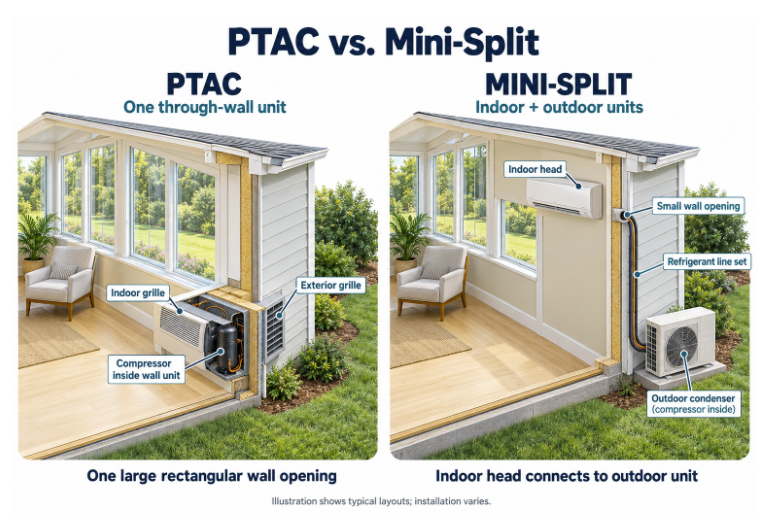
If you have stayed in a hotel, you have seen a PTAC (Packaged Terminal Air Conditioner). It is the box set into the wall under the window. The compressor and the fan sit together in that one box. In a sunroom, we mount it through one exterior wall. There is no separate outdoor unit, which helps when your yard is short on space.
What is a ductless mini-split?
A mini-split splits the job in two. The fan, which we call the head, goes inside the sunroom. The compressor sits outside. A thin line connects them, and it needs only about a three-inch hole in the wall, according to ENERGY STAR. No ductwork is needed, which matters because most sunrooms have none.
You have two head choices. A wall head is the most common and costs less. A ceiling head (sometimes called a cassette) has four vents that push air toward all four corners, so the air drifts down the walls instead of blasting you in your chair. It also frees up wall space. Every time we have installed a ceiling head in a sunroom, the homeowners have raved about it.
| Features | Where it lives | Wall opening | Ductwork needed | Noise | Outdoor space needed | Best-known use |
|---|---|---|---|---|---|---|
| PTAC | One box through the sunroom wall | Large rectangular cut | No | Louder, since the compressor is in the wall | None | Three Seasons Plus and All Seasons Sunrooms |
| Ductless mini-split | Indoor head (wall or ceiling) plus an outdoor unit | About a 3-inch hole for the line | No | Quieter, since the compressor is outside | Room for a small outdoor unit | Sunrooms and year-round rooms |
Which one costs less to run?
Both are efficient choices, and both carry a yellow EnergyGuide label so you can compare. In our experience, the mini-split usually comes out a little ahead because its technology is newer. The U.S. Department of Energy notes that ductless mini-splits can reach ratings as high as 35 SEER2. SEER2 stands for Seasonal Energy Efficiency Ratio 2. It is a score that tells you how much cooling a system gives you for each unit of electricity it uses over a whole cooling season. The higher the number, the less electricity it takes to keep the room cool. ENERGY STAR reports that certified mini-splits use up to 60% less energy than standard electric radiators or baseboard heat.
There is also a hidden cost to noise. Some of our PTAC customers turn the unit off in winter and plug in a small space heater, just so they do not have to hear the compressor running in the wall. That means paying for two systems.
| System | Upfront installed cost | Running cost | Comfort and noise | Best value if you… |
|---|---|---|---|---|
| PTAC | About $2000 to $2500 | Efficient, but usually a bit higher | Louder in the room | Need a low upfront cost and use the room now and then. Perfect if you are not running it all the time. |
| Mini-split | About $3,500 to $6,000 | Usually lower | Quiet inside | Want the room comfortable and affordable year-round |
Which works better in a Shenandoah Valley sunroom through winter and summer?
A sunroom has more glass and thinner walls than the rest of your home, so it feels every swing in the weather first. And the Valley swings hard. There is plenty of humidity, and cold snaps dip well below the average temperature. Both units will keep the room as hot or cold as you want it.
Can a mini-split keep a sunroom warm on the coldest Valley mornings?
Yes, if you choose the right model. We select the right-sized model for your space. Cold-climate mini-splits with features like hyper-heating can hold 100% of their heating power down to 5°F and keep running to about -13°F. A PTAC with a heat pump does fine in mild weather, but it often leans on electric backup heat when the temperature drops, and that costs more to run.
Will either system work on an older or historic home?
Many Valley sunrooms are additions on older homes. The good news: we have never had either system rejected by a homeowner, neighbor, or historic district review board, so it has never been a problem on a job. We always try to place the unit where you will not see it from the front of the house. Keep in mind that a mini-split needs only a small hole for its line, while a PTAC needs a rectangular opening cut through the wall.
Does the sunroom itself matter?
It does. Comfort depends on the unit and the room around it. Single-pane glass or leaky seals will fight any system. If your sunroom struggles, upgraded windows or a better-insulated room may help as much as the new unit. Our guide on choosing a sunroom or porch for the Valley climate covers this in more detail.
| Sunroom situation | Better pick | Why |
|---|---|---|
| Year-round living space | Mini-split | Quiet, efficient heat and cool through big swings |
| Three-season room used now and then | PTAC | Lower upfront cost, self-contained |
| Sunroom on a historic or older home | Either, placed out of sight | Minisplit needs a solid wall or ceiling to mount on. PTAC can go in the sunroom wall system |
| Small lot or tight side yard | PTAC | No outdoor unit to find room for |
| Lots of glass, cold mornings | Mini-split | Holds heat output in the cold |

How long do PTACs and mini-splits last in a sunroom, and what maintenance do they need?
We expect either system to last 10 to 20 years. That is a wide range, and we have seen both ends of it. We have seen units fail in five years, and we have seen 20-year-old units still going strong. The difference usually comes down to how hard the unit works and how well the owner keeps it clean. Most units also carry a two- to five-year manufacturer warranty on parts, so an early failure is covered.
What is the most common maintenance mistake?
A dirty filter. Hands down. We regularly get calls saying a PTAC or mini-split is not keeping up. When we arrive, the filter is packed with lint and dust. We show the homeowner how to clean it, and the problem goes away.
The fix is simple:
- Slide the filter out. It is washable, so there is nothing to buy.
- Rinse it off and let it dry.
- Slide it back in.
Monthly is great. Quarterly is a good, realistic target. A sunroom can collect extra pollen and dust from open doors and windows, so do not let it go a full year. Beyond the filter, both systems are close to maintenance-free.
So, should you choose a PTAC or a mini-split for your sunroom?
It all comes down to how you plan to use the room.
- Choose a PTAC if your budget is tight, you use the sunroom now and then, or your side yard has no room for an outdoor unit.
- Choose a mini-split if you want to live in the sunroom year-round, you want a quiet room, or you want the lowest energy bills over time. If comfort is the top goal, ask about a ceiling head.
- Have a large sunroom or a sunroom plus an open adjoining space? Ask us about a larger or multi-zone mini-split so one system can cover both.
Now you know the trade-off. A PTAC saves money on day one. A mini-split is quieter, a bit more efficient, and better at handling the Valley’s cold mornings and muggy afternoons. For most sunrooms that people want to use all year, that is why we usually lean toward the mini-split. But the right answer is the one that fits your room, your budget, and your plans.

Want to see what a clean install looks like? Browse our sunroom project gallery.
When you are ready for a straight answer about your own sunroom, book a free consultation with one of our project consultants. We will look at the room, measure the space, and tell you honestly which system will keep you comfortable in every season.