
By Anson Martin
What if the choice for your flat roof, EPDM or TPO, is the difference between a smart buy and a soggy, sagging regret? If you have a flat or low-slope section, you have probably met two similar-looking layers and two confident salespeople, one waving a black sheet and one waving a white one. It is enough to freeze anyone in place. At Valley Roofing & Exteriors, with 22 years of putting both membranes on Valley roofs, we have watched which ones age gracefully and which ones fail early. By the end of this article, you will know the real differences, the honest cost picture, and how our climate tips the scale. This is written for the homeowner or building owner weighing the two options.
What is the difference between EPDM and TPO roofing?
EPDM stands for ethylene propylene diene monomer. That is a mouthful, so most people just call it the black rubber roof. It has been protecting low-slope buildings since the 1960s. TPO stands for thermoplastic polyolefin, a plastic-based membrane that is usually bright white and arrived in the 1990s. Both are single-ply membranes, which means one tough sheet is enough for waterproofing.
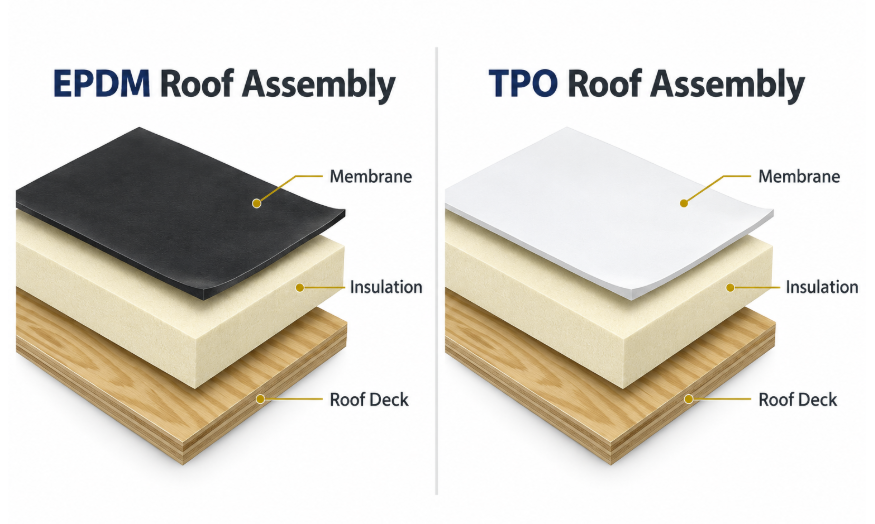
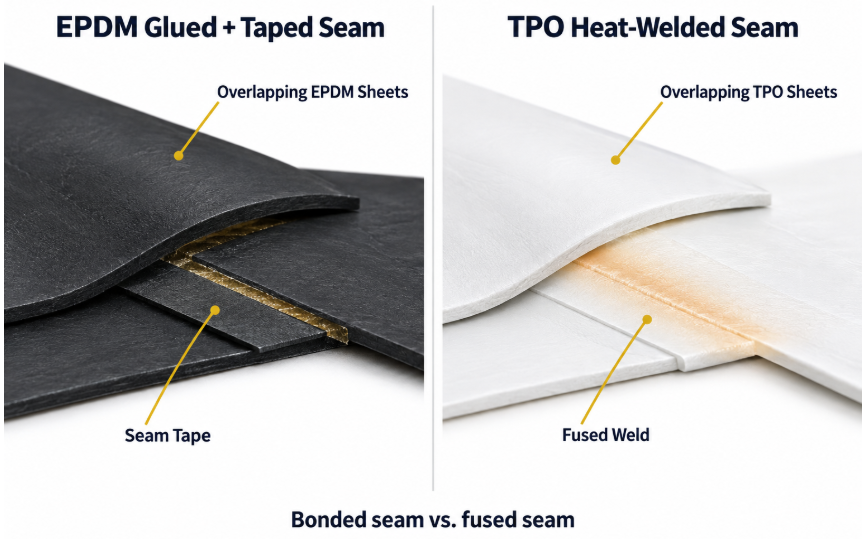
Four things truly set them apart: color and reflectivity, how the seams are joined, how flexible the sheet stays, and how each handles a puncture.
| Feature | EPDM | TPO |
|---|---|---|
| Material | Synthetic rubber | Thermoplastic (plastic-based) |
| Common color | Black (white available) | White and reflective |
| Seams joined by | Glue and seam tape | Heat-welded into one piece |
| Reflects the sun (a “cool roof”) | Low | High |
| Cold-weather flexibility | Excellent | Good |
| Puncture resistance | Good | Higher |
| On the market since | 1960s | 1990s |
Which flat roof holds up better in Shenandoah Valley weather?
The Valley is its own animal. Here in the Shenandoah Valley and Central Virginia, we get wide temperature swings and hard freeze-thaw winters, humid summers with strong sun, hail and gusty wind spilling off the Blue Ridge, real snow load, and street after street of historic homes with low-slope porches and additions where looks matter as much as leaks.
Those conditions pull the membranes in different directions. Cold, cycling weather rewards EPDM, because rubber stays soft and forgiving when the temperature drops. Hot, sunny weather rewards TPO, because a white surface bounces the sun away. The U.S. Department of Energy notes that a dark roof can top 150°F on a summer afternoon, while a reflective roof can stay more than 50°F cooler. According to Energy Star, on a small residential section, that heat gap barely moves your bill. On a big commercial roof, it moves it a lot.
| Valley condition | How EPDM handles it | How TPO handles it |
|---|---|---|
| Hot, sunny summers | Black soaks up heat | Reflects heat, stays cooler |
| Cold snaps and freeze-thaw | Stays flexible and forgiving | Holds up well, a touch stiffer |
| Hail and impact | Good | Higher puncture resistance |
| Snow and standing water | Sheds slowly; keep it clear | Welded seams shrug off ponding |
| Historic-home looks | Blends in when black is required | White can clash in a historic district |
How much do EPDM and TPO roofs cost to install and maintain?
For a typical residential low-slope roof, the price difference is small. Installed, both usually land around $5 to $12 per square foot. TPO can cost a little more on some components, but EPDM leans on adhesives, primers, and seam tapes that are not cheap either, so the two tend to even out. What really moves your number is roof size, tear-off, insulation, the condition of the deck, and how hard the roof is to reach. Our roof replacement cost guide walks through those levers.
Upkeep is nearly identical and simpler than you might fear. A low-slope roof does not shed debris the way a steep one does, so twigs and leaves settle in and slide toward the drains. Clear them off, keep the drains open, and either membrane will reward you.
- What you are comparing
- Installed cost (per sq ft)
- Repairs
- Summer energy impact
- Biggest upkeep
- EPDM
- About $5–$11
- Simple patch with adhesive
- Little to none
- Clear debris, keep drains open
- TPO
- About $5.50–$12
- Re-weld by a trained crew
- Can trim the cooling load
- Clear debris, keep drains open
Which lasts longer, EPDM or TPO?
This is where the installer matters as much as the material. Each membrane fails in its own way. EPDM usually gives out at the seams, or from shrinkage and the odd puncture, as glue and tape loosen while the sheet stretches and pulls on itself over the years. TPO trouble almost always traces back to a weak weld or, on much older formulations, surface weathering. Welded correctly, the two TPO sheets melt into one piece, and that bond holds long after glue would have let go.
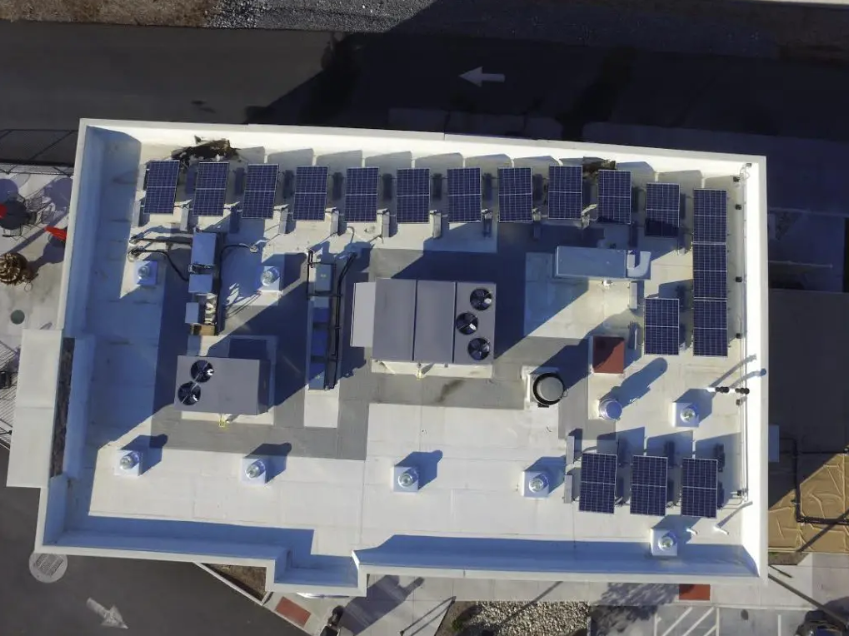
Picture of Valley Roofing & Exteriors TPO project
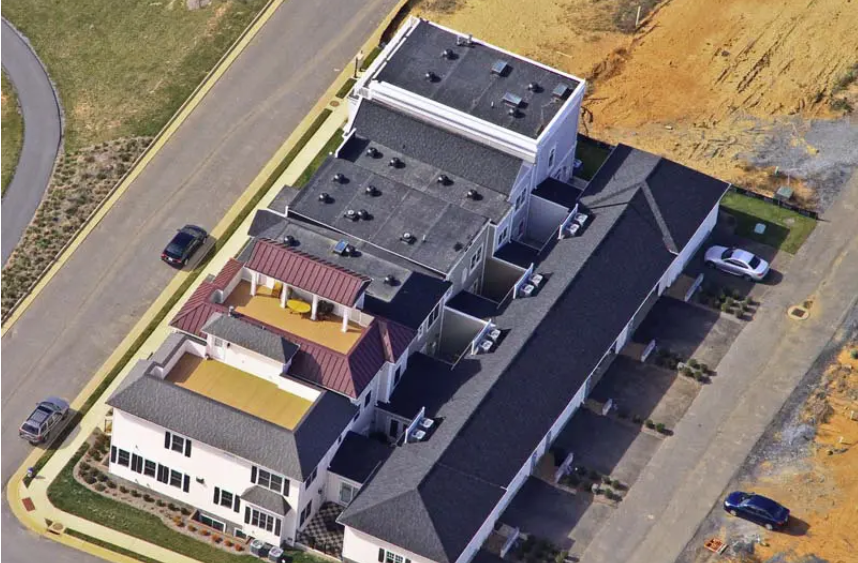
Picture of Valley Roofing & Exteriors EPDM project
On paper, both last a similar 20-to-40-year window. The EPDM Roofing Association documents decades of field service, Carlisle SynTec backs its systems for up to 30 years, and modern GAF TPO is engineered to go the distance. A great crew is what turns that spec-sheet number into a real one.
Is EPDM or TPO the better choice for your roof?
The biggest mistake we see is picking a favorite and pushing it on every roof. There is a real place for both, and the right call depends on your roof, not on what a salesperson likes to sell. A roof full of valleys, a chimney, and a cricket needs the flexibility EPDM brings, because its adhesives wrap tricky corners better than a weld. A clean, square roof lets us heat-weld TPO into one solid sheet. Color, slope, and setting fill in the rest.
Because we install both, our advice is tied to your roof, not to our shelf. Here is how we usually think it through:
| Your situation | We usually reach for |
|---|---|
| A cold, shaded, or oddly shaped roof (valleys, chimney, cricket) | EPDM |
| A hot, sun-baked roof, or a large commercial roof | TPO |
| A historic district that requires a black roof | EPDM |
| A clean, square, straight low-slope roof | TPO |
| No strong feeling about color | We read the roof and decide together |
Which is the smarter decision for your roof?
The bottom line is that neither membrane wins every roof, so the smart move is to match the material to your situation. For a cold, shaded, or oddly shaped roof, one with valleys, a chimney, and a cricket, EPDM is usually the best call, because its flexible rubber and adhesives wrap tricky corners better than a weld can. For a hot, sun-baked roof, or any large commercial building where cooling bills stack up, TPO is usually best, because its white surface reflects the heat away. A clean, square, straight roof also favors TPO, since we can heat-weld it into one solid sheet. And when a historic district requires a black roof, EPDM is the natural fit. If you have no strong feeling about color, we will read the roof and settle it with you.
Whichever way it goes, match the membrane to the roof and the climate, then match the installer to the membrane. Get those two right, and either black rubber or bright white will serve you for decades. Get them wrong, and even the better material may leak.
Want to see what done right looks like on each type of home? Take a slow scroll through our project gallery.
When you are ready, book a discovery call and one of our project consultants will read your roof with you and give you an honest recommendation for your home.