

By Alan Martin
When a Shenandoah Valley homeowner asks us to compare deck railing systems, we always start with two questions before we ever talk products:
-
- How much maintenance are you willing to live with?
- What is your budget?
Those two answers narrow the field faster than anything else, because the six common railing systems, wood, composite, aluminum, cable, glass, and vinyl, sit at very different points on both scales.
Here is how we walk our clients through the real differences, drawing on what we have seen hold up (and fail) on decks across the Shenandoah Valley.
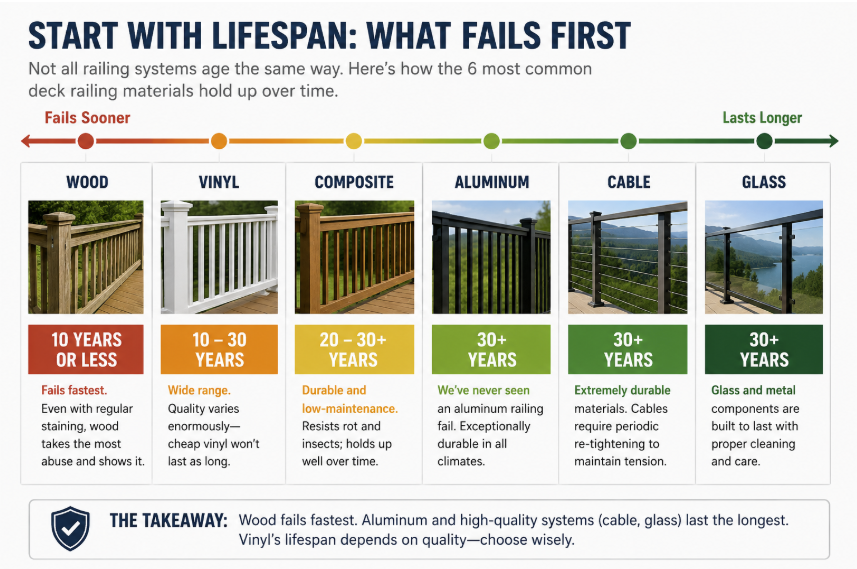
Start With Lifespan: Which Fails First?
Wood fails fastest, hands down. Even with regular staining, a wood railing can fail in ten years or less. It takes the most abuse of any component on a deck, and it shows.
At the other end of the spectrum, we have never seen an aluminum railing fail. Vinyl falls somewhere in between, and here is the catch: vinyl quality varies enormously. There are very cheap vinyl products, and there are very nice ones, and the lifespan difference between them is dramatic. We do not use the cheap big-box vinyl for exactly that reason.
What Is The Most Common Mistake People Make When Choosing A Deck Railing?
Most people assume the biggest homeowner mistake is choosing a railing on price alone. In our experience, it is actually choosing the wrong person to install it.
With a wood railing, installation quality matters less because you are only going to get about ten years out of it. But it is not uncommon for us to visit an older vinyl system that is loose because it simply was not installed correctly. Often the original contractor went cheap and used wood posts inside the vinyl sleeves instead of the aluminum posts that the better systems call for. The product was fine; the installation failed it. A railing is a safety system first and a design feature second, so who installs it matters as much as what you pick.
What Does Virginia Code Require?
A few numbers every deck owner should know. Residential guardrails are typically 36 inches tall, with 42 inches for commercial applications. Baluster spacing must be 4 inches or less, small enough that a toddler cannot fit through. And the railing needs to withstand roughly 250 pounds of force against it.
This is where DIY jobs most often fall short. We regularly see 6- or 8-inch baluster spacing on homeowner-built railings, which is a genuine child-safety hazard, along with weak fastening that would never hold up to a real load. If you inherit a deck with an older railing, these are the first things to check.
What About Color, Grip, and the Small Details That Matter Daily?
Color options eliminate whole systems for some homeowners. Vinyl is essentially only available in white and an almond tone; if you want a black or dark railing, vinyl is off the table. Cable railing typically offers color choices for the posts and framing. Glass is, well, glass.
Handrail feel matters more than people expect, especially for older family members. Aluminum has a thinner top rail that is easy to grasp. Vinyl rails are bulky; unless you have large hands, they are hard to grip comfortably. An ADA-compliant hand bar can be added, though it makes the profile bulkier still.
| Feature | Wood | Aluminum | Vinyl | Composite | Cable | Glass |
| Available Colors | Paint or stain in virtually any color | Many powder-coated colors (black is most popular) | Primarily white and almond | Several manufacturer colors | Posts available in multiple colors | Clear panels with frame color options |
| Handrail Grip | Comfortable, customizable profiles | Slim profile that’s easy to grip | Thick, bulky profile; can be difficult for smaller hands | Similar to vinyl depending on manufacturer | Depends on post material | Depends on frame style |
| Cocktail Rail Option | ✓ Easily added | Limited (available on select premium systems) | ✓ Excellent option | ✓ Available on many systems | Usually not practical | Usually not practical |
| Scratch Visibility | Scratches blend into natural wood | Painted finish can scratch but is easy to touch up | Doesn’t chip like painted metal | Surface can scratch; touch-up options vary | Metal posts can scratch | Glass can show scratches if damaged |
| Best Everyday Advantage | Warm, natural feel | Comfortable grip with virtually no maintenance | Wide top rail for drinks | Coordinates with composite decking | Nearly unobstructed views | Premium, uninterrupted views |
One point in vinyl’s favor: it accommodates a cocktail rail, a flat top wide enough to set a drink on. Our standard aluminum system does not, and the alternate that does is expensive.
As for durability of the finish, any painted metal railing, and composite as well, can scratch, not from normal wear, but from a tree branch or from furniture banging up the steps. The good news is that touch-up paint makes those scratches easy to fix.

The Honest Maintenance Comparison
Wood demands the most: regular staining, and a lot of it, to reach even its modest lifespan. One way to soften that burden is mixing materials; metal balusters between wood top and bottom rails means you are only ever repainting two boards. You can also step up to tropical hardwoods for a genuinely beautiful, longer-lasting wood railing.
Cable railing carries a maintenance obligation many homeowners do not anticipate: the cables slacken over time and need continual re-tightening. It is an easy task, but it never goes away.
Glass railing is gorgeous, and outdoors you will pay for that beauty in cleaning. Even with some self-cleaning capability, plan on wiping it down monthly.
Aluminum and quality vinyl are the low-maintenance winners. Aluminum in particular asks almost nothing of you.
| If you want… | Choose… |
| The easiest railing to grip | Aluminum |
| A place to set drinks | Vinyl (cocktail rail) |
| The most color options | Wood or Aluminum |
| The cleanest view | Cable or Glass |
| The least maintenance | Aluminum |
What Each System Costs
Rough per-linear-foot pricing for the Valley: pressure-treated wood runs about $50 to $60, vinyl about $125, aluminum $125 to $150, composite around $175, and cable and glass both typically exceed $200. The step up from wood, which barely costs anything in materials, to every other system is the biggest jump on the chart.
Here is a pricing quirk worth knowing: on the open market, aluminum usually costs about 50% more than vinyl. Because we have an excellent aluminum source, our aluminum system prices out the same as good vinyl, sometimes slightly less. That changes the math for a lot of our clients, since aluminum’s durability normally comes at a premium.
If you are budget-conscious, pressure-treated wood is the route to take. If you are looking for longevity and can afford it, cable and glass are the way to go. Talk to a professional and get an honest recommendation for your financial situation and preferences.
Which Railing Fits an Older or Historic Home?
Wood is accepted in virtually every historic district and older HOA. The second-easiest approval is usually aluminum. Because its profile resembles old cast iron railing, review boards tend to sign off on it quickly. If you are in one of the Valley’s historic areas, those two systems will save you headaches.
One Pairing to Avoid, and Our Favorite Combination
We generally advise against putting a wood railing on a composite deck. You are pairing the shortest-lived component with the longest-lived deck surface, and in our view that is throwing money away.
The reverse pairing, though, we do all the time: wood deck boards with aluminum railing. It softens the project, and a black aluminum railing on a wood deck is probably the single best look we build.
What Is the Bottom Line?
If a homeowner wants the best view with the least maintenance, we steer them to aluminum rail, thin profiles that disappear against the scenery, no failures in our experience, easy to grip, and (with the right supplier) priced like vinyl. Asked what we would put on our own houses, the answer is the same: aluminum.
That said, the right railing is the one that matches:
-
- your budget
- your tolerance for upkeep
- your neighborhood’s rules
- the person installing it
Get those four right and any of these systems can serve you well.
Ready to Install Railings on Your Own Deck?
If you are weighing railing options for a new deck or replacing a system that has seen better days, we would love to take a look.
Contact us today for a free consultation, and we will walk your deck with you, talk through maintenance, code, budget, and recommend the system that perfectly fits your home.