

By Alan Martin
Is that tired old deck headed straight for the dumpster, or is there still some life left in those boards?
If you are planning a new deck, you have probably wondered what happens to the old one. Maybe you hate the thought of a mountain of lumber and plastic rolling off to the landfill. Maybe you have heard that “eco-friendly” decking is just a fancy label for flimsy, overpriced boards. Either way, you want a deck that lasts. And you do not want to waste good material, or good money, to get it.
At Valley Roofing & Exteriors, with our 20+ years of experience building and rebuilding decks across Central Virginia, we know not every homeowner is going to choose us. And that is okay. You deserve a quality deck no matter who you hire.
In this article, we will walk you through what “recycled decking” really means, which parts of an old deck can actually be saved, how much recycled material is inside today’s composite boards, and when real wood is still the better pick. We wrote this so you can source from the best in the business and ask any contractor the right questions.
What does “recycled decking” actually mean?
When homeowners say “recycled decking,” they usually mean one of two very different things. The first is repurposing: taking parts of your existing deck, like the framing or railing, and putting them back to work. The second is recycled-content decking: brand-new boards made from plastic and wood waste that would otherwise sit in a landfill.
Here is the truth from our job sites. Repurposing comes up all the time. Sending old deck parts off to a recycler to be melted down and remade? That is rare.
| Term | What it means | How often we see it on Valley jobs |
|---|---|---|
| Repurposing | Reusing parts of your existing deck on the new build | Very often. Customers ask about it regularly. |
| Recycled-content composite | New boards made mostly from recycled plastic film and reclaimed wood | On most of the composite decks we build |
| Recycled-content PVC | Solid PVC boards that include some recycled material | On some PVC product lines |
| Material recycling | Old aluminum or steel railing melted down into new products | Rarely |
Why does this matter for Shenandoah Valley homes?
Our region is tough on decks. Humid summers soak framing, and freeze-thaw winters work fasteners loose, season after season. Many Valley homes also have decks that were built decades ago from basic pressure-treated lumber. That means what you can save depends on what you started with and how well it has survived through the years. A careful, board-by-board inspection is the only way to know for sure.
What parts of an old deck can actually be reused?
The biggest misconception we hear is that most of an old deck can be reused. In reality, the list is limited. Nearly every piece of a deck is cut to fit one specific space, so it rarely fits anywhere else.
A railing is a good example. We regularly take a railing down, rebuild the deck underneath it, and then put the original railing right back on. That works because it is going back to the same house. Taking that same vinyl railing and trying to fit it on a different house is a whole different story. It is very hard to do well.
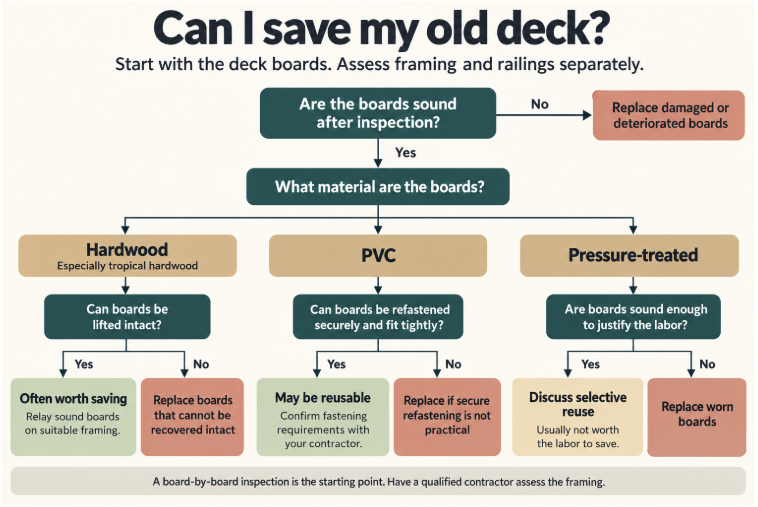
The quality of your boards matters most. When a homeowner has tropical hardwood decking, it is almost always worth saving. We have taken those decks apart, rebuilt the framing, and laid the original hardwood boards back down. It works beautifully. PVC boards are trickier. Once the original fasteners come out, it is hard to get the boards tight again when they are laid back down.
| Deck part | Can it be reused? | What we have seen |
|---|---|---|
| Railing, same house | Often | We remove it, rebuild the deck, and reinstall the original railing |
| Railing, different house | Rarely | It was cut to fit the first deck, so it seldom fits a new one |
| Framing | Sometimes | Only sections that are still sound after inspection |
| Tropical hardwood boards | Often | Worth the labor to lift and relay on new framing |
| PVC boards | Sometimes, with limits | Hard to get tight again once the original fasteners come out |
| Standard pressure-treated boards | Rarely | Usually not worth the labor to save |
| Aluminum or steel railing | Yes, through recycling | Metal can be melted down and made into new products |
The rule of thumb is simple: better materials up front mean more you can save later. If your deck has high-quality finishes, reuse is worth a conversation. If it is cheap pressure-treated wood, it is probably not.
Is composite decking made from recycled materials?
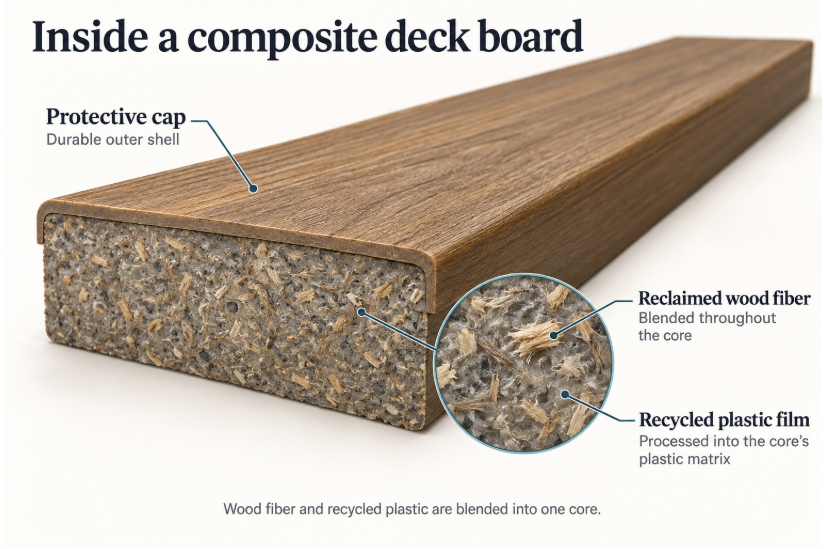
Yes. Most of the composite deck boards we install are made largely from recycled material. This is where the recycling story really comes full circle.
Trex says its composite decking is made from about 95% recycled and reclaimed materials, including plastic film that would normally head to the landfill and reclaimed wood. Trex runs manufacturing facilities right here in Virginia.
Many solid PVC deck boards include some recycled material too, though the amount varies by brand. Always check the manufacturer’s stated recycled-content percentage before you buy.
We make a point of mentioning recycled content when we talk with homeowners about composite deck boards. Some people care a great deal, and some do not. Either way, it is worth knowing what you are walking on. For a deeper look at capped, uncapped, and PVC boards, read our guide to types of composite deck boards.
Is recycled or repurposed decking really better for the environment?
Typically, yes. The product already exists, so reusing it skips new manufacturing. When we save sound framing, fewer trees need to be cut down. When old aluminum or steel railing gets recycled, that metal goes back into use instead of new material being dug from the ground.
The bigger picture matters too. Building materials and construction account for roughly 11% of energy-related carbon emissions, according to the World Green Building Council, as reported by the American Chemical Society. Researchers have even developed a composite decking that stores more carbon dioxide than it releases over its life, and it runs about 18% cheaper than standard composite boards.
To be fair, composites are not perfect. They still contain plastic, and they are harder to recycle at the end of their life than untreated wood. Recycled content is a real benefit, but it is one piece of the puzzle, not the whole picture.
When is real wood a better choice than recycled composite decking?
There is a place for both. Sometimes the choice is driven by budget, and a homeowner simply needs the lower upfront price. Other times it is about feel. Real wood has a softness and a realness underfoot that composite boards cannot duplicate.
We do not install a lot of tropical hardwood, but we do install a lot of thermally modified oak. It is a much nicer deck board than composite. If you want a natural, premium deck, it deserves a serious look.
| Decking option | Recycled content | Look and feel | Best for |
|---|---|---|---|
| Composite | Up to about 95% (Trex) | Wood-look grain, very uniform | Low upkeep and recycled content |
| Solid PVC | Some, varies by brand | Smooth and consistent | An all-synthetic board |
| Pressure-treated pine | None, new lumber | Real wood, needs regular stain and seal | Tight budgets |
| Thermally modified oak | None, but real wood | Rich, natural, soft underfoot | A premium, real-wood deck |
| Tropical hardwood | None, but real wood | Dense and luxurious | Long-life decks that are worth saving later |
Wondering how these options compare on price? Our deck pricing guide breaks down the real numbers.
Is a recycled or repurposed deck right for your home?
Now you know the difference between repurposing and recycled content. You know that railing can often go back on the same house, that hardwood is worth saving, and that PVC and cheap pressure-treated boards rarely are. You also know that most composite boards are already packed with recycled plastic and wood, and that real wood still earns its place.
If you are planning a deck for next season, now is the time to ask your contractor what can be saved and what your new boards are made of. Smart questions today mean fewer regrets tomorrow.

Want to see what quality deck work looks like? Browse our project gallery. When you are ready to talk through your own deck, book a free estimate and meet with one of our project consultants. We will tell you honestly what is worth keeping and what is not.