

By Ben McDorman
Is that low, lazy stretch of roof over your porch quietly soaking your ceiling while you sleep? You see the stain spreading across the drywall. You climb a ladder, squint at the shingles, and wonder whether the whole roof was a mistake, or whether someone cut a corner years ago.
We understand that worry. At Valley Roofing & Exteriors, we have spent 20+ years on Shenandoah Valley roofs, and low-slope leaks are one of the most common calls we get. We have chased these leaks from the attic up, tested what actually holds, and learned exactly where shingles stop working.
This guide is for the homeowner staring at a shallow roof, a stained ceiling, or a contractor’s quote and feeling unsure. We will explain when shingles are safe on a low slope, when they are risky, and what it takes to protect them, in plain language.
What makes a Central Virginia roof harder to keep dry?
The Shenandoah Valley throws a lot at a roof. Our winters bring wet snow that melts by day and refreezes by night, and that freeze-thaw cycle is rough on any shallow slope. Then there are our older farmhouses and historic homes. Many carry low porch roofs, shed dormers, and additions built long before modern underlayment existed. The result is a region full of roofs that were never designed to move water quickly.
On a steep roof, gravity does the work. Water races to the gutter and is gone in seconds. On a low slope, water crawls. It lingers, pools in low spots, and hunts for any seam, nail, or gap to slip through. In our climate, slow water is the real enemy.
Can you actually put shingles on a low-slope roof?
The short answer is yes, but only so far. The International Residential Code allows asphalt shingles on slopes of 2:12 or steeper. That means two inches of rise for every twelve inches of run. Go any flatter than 2:12 and shingles are simply not rated to keep water out.
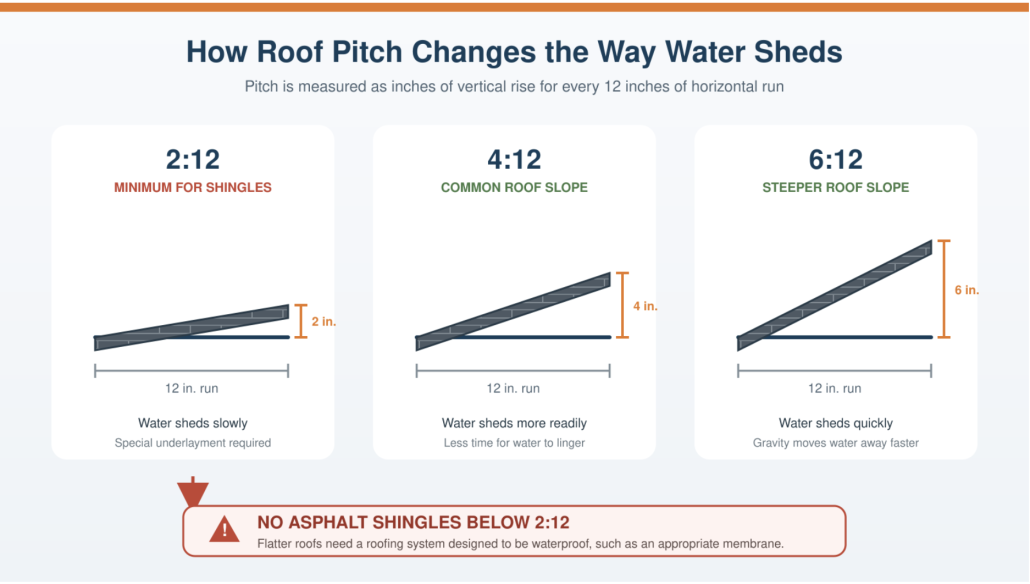
We will install shingles down to a 2:12 pitch. Below a 3:12, though, the approach changes, because water sheds slower and sits longer. Manufacturers will warranty a shingle roof at 2:12 when it is built to their specifications. We have installed roofs to those exact specifications and still watched a 2:12 slope leak. A warranty is a promise on paper. Water does not read the paperwork.
| Roof pitch | What we install | Why |
|---|---|---|
| 4:12 and steeper | Standard shingle system | Water sheds fast, so risk is low |
| 3:12 | Shingles over a double layer of underlayment | Water lingers longer and needs a backup |
| 2:12 | Shingles over a full ice-and-water leak barrier, or we recommend metal or TPO | Shingles are at their absolute limit |
| Below 2:12 | No shingles, flat membrane or metal only | Shingles will leak, every single time |
What is the difference between shedding water and staying waterproof?
Picture a rain jacket. A waterproof jacket can be dunked in a lake and keep you dry. A water-resistant jacket sheds a light drizzle, but soak it and the water seeps through.
Shingles are water-resistant, not waterproof. They shed water; they do not seal it out. A flat roof membrane, such as TPO, is genuinely waterproof. Every seam is heat-welded or glued and taped into one continuous, watertight skin, so water can sit on the surface and never find a way in. That single difference is why slope matters enormously for shingles and hardly at all for a membrane.
| Feature | Shingles (water-resistant) | Flat membrane / TPO (waterproof) |
|---|---|---|
| How it keeps water out | Overlaps that guide water down and off | Sealed, continuous seams |
| Does it need slope? | Yes, it must shed water fast | Very little |
| Standing water | Leaks every time | Fine; the National Roofing Contractors Association standard allows up to 48 hours |
Why do low-slope shingle roofs still spring leaks?
When water cannot run off fast enough, it begins working its way backward. An architectural shingle is built in two layers, and that lower layer leaves a small shelf on the back of each shingle. Slow-moving water catches on that shelf, backs up, and creeps underneath the shingle, sometimes half an inch, sometimes much farther.
The real damage happens at the nails. As water tracks backward, it reaches the fasteners. Nail heads rust, corrode, and open a path straight into your attic. This is why we run a full ice-and-water leak barrier on low slopes: it is designed to seal tightly around each nail as it is driven. It does not work 100 percent of the time, but it is your strongest line of defense. And never forget the golden rule of a shingle roof: if water ponds, it will leak. Shingles must shed to survive.
Low slopes make ice dams worse, too. The roofs we watch dam up are usually 4:12 or flatter with wide overhangs of 16 inches or more. Snow melts, slides toward the cold eave, refreezes, and shoves water back up under the shingles where it was never meant to go.
When should you choose metal or a flat membrane instead?
When a roof drops to 2:12, we do not just hand you shingles and wish you luck. Every time we bid a 2:12 replacement, we walk you through two options that simply perform better on a shallow slope: standing-seam metal or a membrane. Read more about which flat roof is best for your home.
| Option | Best slope | Why it works | Trade-off |
|---|---|---|---|
| Asphalt shingles | 3:12 and up (2:12 is the limit) | Familiar and budget-friendly | Highest leak risk when flat |
| Standing-seam metal | Performs well at low pitches | Sheds fast, sealed seams, long lifespan | Higher upfront cost |
| Membrane | Nearly flat roofs | Fully waterproof, handles ponding | A different look than shingles |
There is no single right answer for every home. The best roof depends on your slope, your budget, and how the roof looks from the street. Our job is to lay out the honest trade-offs so you can choose with open eyes, not to talk you into the most expensive option.

Frequently asked questions about low-slope shingle roofs
What is the lowest slope you can put shingles on?
Building code allows asphalt shingles down to a 2:12 pitch, which is two inches of rise for every twelve inches of run. We will install them that low, but we add a full ice-and-water leak barrier and often recommend metal or a membrane instead. Anything flatter than 2:12 should not carry shingles at all.
Is a 2:12 roof the same as a flat roof?
No. A 2:12 roof is a low-slope roof, not a true flat roof, though the two are easy to confuse from the ground. Shingles can work on a low slope with the right protection, but a genuinely flat roof needs a waterproof membrane such as TPO or EPDM.
Will the shingle manufacturer still warranty my low-slope roof?
Usually yes, as long as the roof is installed to the manufacturer’s exact low-slope specifications. Keep in mind that a warranty covers defects, not physics. We have built 2:12 roofs to spec and still watched them leak, which is why we are honest about the risk before you decide.
How can I tell what slope my roof is?
Slope is measured as rise over run: how many inches the roof rises over 12 inches of horizontal distance. You can estimate it with a level and a tape measure, but the safest way is to let us measure it during an inspection. Your slope is the single biggest factor in choosing the right roof.
Why does my low-slope roof leak only in heavy or long rains?
Because shingles shed water rather than seal it out. In a short shower, water runs off before it can back up. In a heavy or lasting rain, water arrives faster than it can drain, ponds in low spots, and works its way backward under the shingles to the nails. That is the moment a shallow slope shows its weakness.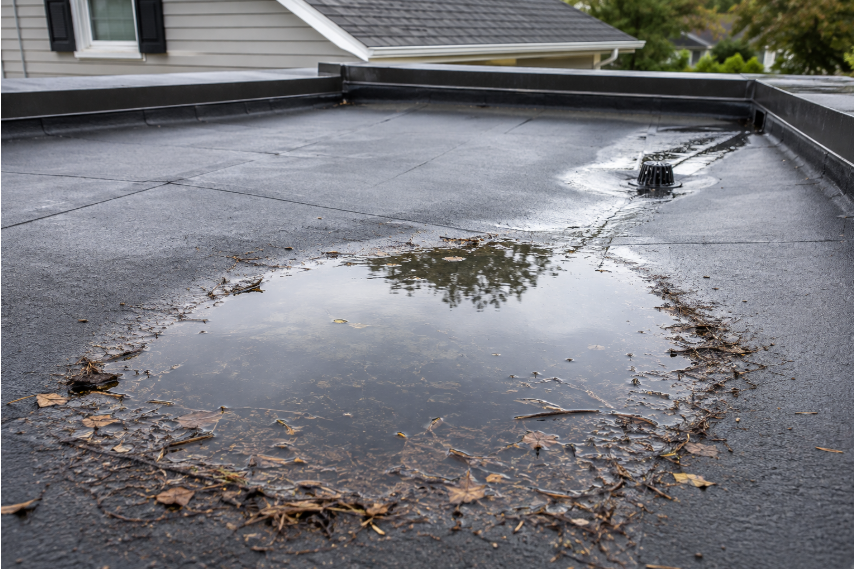
Is a metal or TPO roof worth the higher cost on a low slope?
Often, yes. On a shallow slope, standing-seam metal and TPO handle water far better than shingles and tend to last longer, which can make them the cheaper choice over the life of the roof. The right answer depends on your slope, your budget, and the look you want, and we will lay out the trade-offs so you can choose with open eyes. Read this article comparing TPO and EPDM with metal roofs.
So, should you trust shingles on your low-slope roof?
Shingles can live on a low slope, down to a 2:12 pitch, but they shed water rather than seal it. The flatter the roof, the harder they have to work and the more backup protection they need. Below 2:12, shingles are the wrong tool for the job, and a metal roof or a flat membrane is usually the smarter, safer buy.

If you are unsure what slope you have, or whether your roof was built the right way, please do not gamble with your home. See what quality work looks like in our project gallery, then book a discovery call with a Valley Roofing project consultant. We will climb up, tell you straight, and help you protect the home underneath.