

By Anson Martin
That $200 patch felt like a win, but what if it is quietly rotting your roof from the inside out?
We understand the pull of a low number. You have a leak, a stranger with a ladder offers to fix it for a fraction of the next quote, and the pain goes away for a while. Nobody wants to overpay, and nobody wants to feel scammed. The trouble is that a cheap roof repair often does not fix the problem at all. It just hides it, and the bill comes back bigger.
At Valley Roofing & Exteriors, we have spent 22 years repairing roofs across Central Virginia and the Shenandoah Valley. We have climbed up behind the low bidders and seen what the shortcut looks like a year later.
This post is for two kinds of homeowners: the one comparing quotes right now, and the one who already paid for a quick patch and is wondering whether it was a mistake. By the end, you will know how cheap repairs fail, what they really cost, and the questions that keep you from getting taken.
What Makes Shenandoah Valley Roofs Different?
Our valley is beautiful, but it is hard on roofs.
-
- Freeze-thaw cycles pry at every gap all winter.
- Humid summers feed mold and rot.
- Storms roll through with wind that finds any shingle that is not sealed down tight.
A sloppy repair that might limp along for years in a mild climate gets tested in this region within a season or two.
The valley also holds a lot of history. Many older homes around Staunton, Waynesboro, and the surrounding towns wear slate roofs, and slate is unforgiving. You need to be extremely careful just walking on a slate roof, because the wrong step breaks the slates around it. We have seen well-meaning crews make the problem far worse before they ever touched the leak. On a slate or historic roof, having a true expert on the roof matters before any work begins.
What Does “Cheap” Roof Repair Actually Mean?
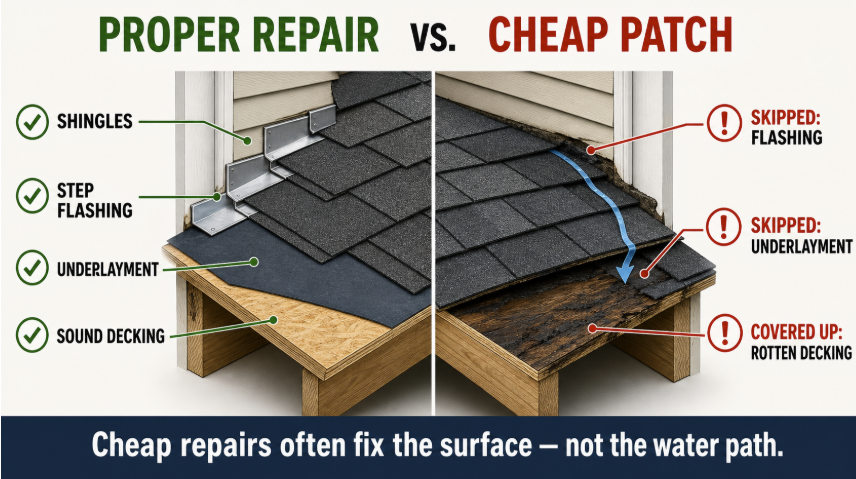
“Cheap” is not really about the price tag. It is about which steps got skipped to reach that price tag. A bargain repair usually means unlicensed labor, mismatched shingles, skipped flashing, no proper troubleshooting, or no warranty behind the work.
| Cheap Repair | Quality Repair | |
|---|---|---|
| Labor | Unlicensed, unvetted | Licensed, insured crew |
| Diagnosis | Glance from the ground | Attic check to trace the true leak |
| Materials | Whatever is on the truck | Matched shingles, correct flashing |
| Sealing | New shingle left unbonded | Shingle sealed to every neighbor |
| Warranty | None | Written workmanship warranty |
| Lifespan | Months to a year or two | Matches the roof’s remaining life |
How Do Cheap Repairs Fail Over Time?
The failures are predictable because the shortcuts are predictable. A lot of contractors do not really know how to repair a roof, so they run up there with a caulk gun, or they grab a bucket of tar and smear it around. Soon you have a mess that can cause further damage, and you are facing a full replacement anyway.
The most common shortcut of all is swapping a single shingle. How hard can it be, right? Pull the broken one, slide a new one in, done! But that new shingle has to glue down and seal to all the shingles around it. Asphalt shingles rely on a self-sealing strip that bonds each shingle to the one above it for wind resistance, and that bond does not happen on its own in cold or shade; see this InterNACHI article for more context. When a crew skips that step, the very next windstorm peels the shingle beside the repair right off.
| Shortcut | Year One | By Year Three to Five |
|---|---|---|
| Tar smeared over a leak | Looks dry, feels solved | Trapped moisture rots decking |
| New shingle not sealed | Passes at quick glance | Neighboring shingles blow off |
| Leak never traced in attic | Stain seems to stop | Water travels, damage spreads |
That last row is the silent killer. Fixing the leak is only half the job. The other half is properly troubleshooting where the water actually comes from. Someone might glance from the ground, see a pipe boot, call it a $300 fix, and drive away. Meanwhile, the water was running down from a chimney or a shingle several feet away. Miss that, and you never got it right.
What Hidden Costs Come With a Bargain Roof Repair?
The repair price is never the real price. Behind a failed patch, you find water damage to decking, soaked insulation, stained drywall, and mold that needs remediation. We have gone out to homes where a homeowner told us, “I paid $1,200 to have this repaired, and it still leaks.” But when we climb up, we cannot even tell that any repair was done.
Insurance will not save you, either. Insurance does not cover sloppy workmanship. If someone goes up on your roof, does the job wrong, and a rainstorm later brings a leak, the carrier sends an adjuster, who reports that this was a workmanship issue and not storm damage. Then they deny the claim because faulty-workmanship exclusions are standard in home policies. The savings you chased up front become a bill you pay alone.
The worst part is who gets hurt. We were once called out to an elderly woman’s home in Waynesboro. She had paid a man thousands of dollars to fix her roof. When we looked at what he had actually done, he had simply wrapped a bungee cord around the chimney. You cannot make that up, and there was no way for her to know. People get taken advantage of far too often, and that is exactly why the questions in the next section matter.
Should You Repair or Replace Right Now?
The age-old question deserves an honest answer, and it is not always “spend more.” If a roof is genuinely old and near the end, and you plan to replace it next year anyway, a small, careful repair to get you through can make sense. But if the roof sits in the middle of its life and you want another five to fifteen years out of it, it is absolutely worth getting the repair done right. We break that decision down further in our roof repair versus roof replacement blog article.
What Should You Ask a Roofer Before Hiring?
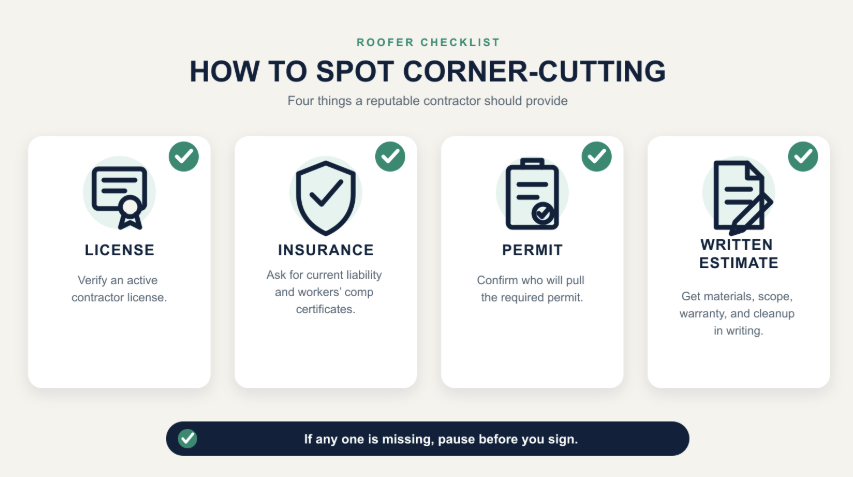
You do not need to be a roofer to avoid a corner-cut job. You just need to ask the right questions and watch how a contractor answers.
| Ask this | A good answer sounds like |
|---|---|
| Are you licensed and insured? | Yes, here is my license number |
| Will you get in the attic to find the leak? | Yes, we will trace the true source |
| Can you show photos of past repairs? | Yes, while explaining how each project is unique |
| Will the new shingles seal to the old? | Yes, hand-sealed if needed |
| Do you stand behind it in writing? | Yes, with a workmanship warranty |
Repairs are tricky, and every one is different, so clear before-and-after photos are not always available. That is fine. What matters is that the person on your roof can explain how they will find the problem, not just cover it.
Ready to Stop Guessing About Your Roof?
Here is what it comes down to. A cheap repair trades a small savings today for a much larger bill later, often resulting in a full replacement you did not need yet. A quality repair protects both your home and your budget, because it fixes the real problem and seals the work so the next storm cannot undo it. In a valley of freeze-thaw winters, wet summers, and irreplaceable historic roofs, getting it right the first time is the frugal choice, not a fancy one.
See what quality work actually looks like in our project gallery. When you are ready, book a discovery call and meet with a project consultant who will get in the attic, find the true source, and give you a straight answer.