

By Ben McDorman
Are you afraid that cutting a hole in your roof for a little more sunlight will buy you a leak, a stain, and a headache? It is a fair fear to have. You do not want a dark, dreary room, but you do not want a drip over your bed either. We get it. Maybe it is the windowless bathroom, the gloomy hallway, or the kitchen that still needs the lights on at noon. You want sunlight, not a gamble.
At Valley Roofing & Exteriors, we have 22+ years of experience installing Shenandoah Valley sun tunnels and skylights, so we have seen firsthand what holds up here and what does not. This article gives you the honest differences in light, cost, install time, and leak risk, plus which choice fits which room and which roof.
What is the difference between a sun tunnel and a skylight?
A skylight is a window in your roof. When you look up at a skylight, you see the sky, the sun, and the birds, the very same as looking out a window.
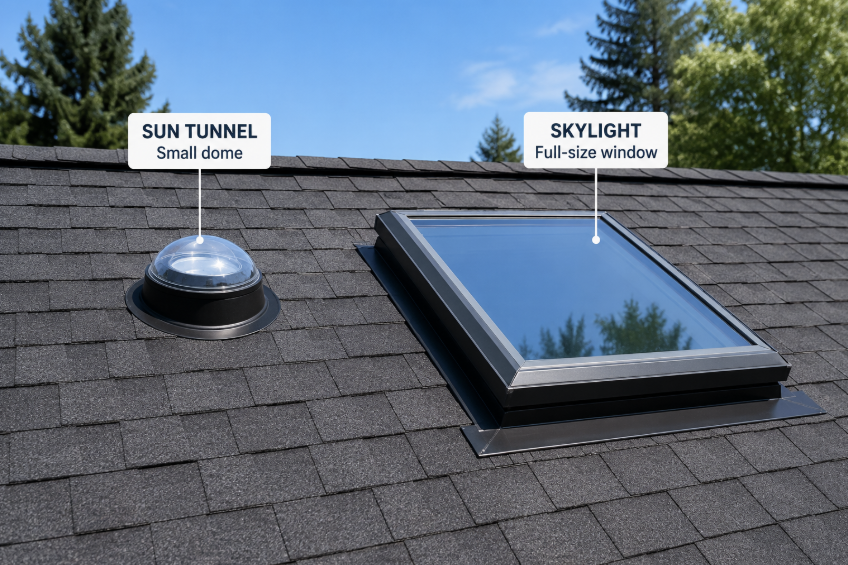
A sun tunnel is different. From inside the house, it looks more like a ceiling light. It is a direct tunnel that carries daylight from a small dome on the roof, down a reflective tube, and into the room through a trim ring and a diffuser. You do not see out of a sun tunnel. It simply pours light in.
That one difference, a view versus no view, drives almost everything else, from the size of the hole in your roof to the price.
We use Velux for both, so the brand is one thing you do not have to puzzle over.
How much do sun tunnels and skylights cost to install?
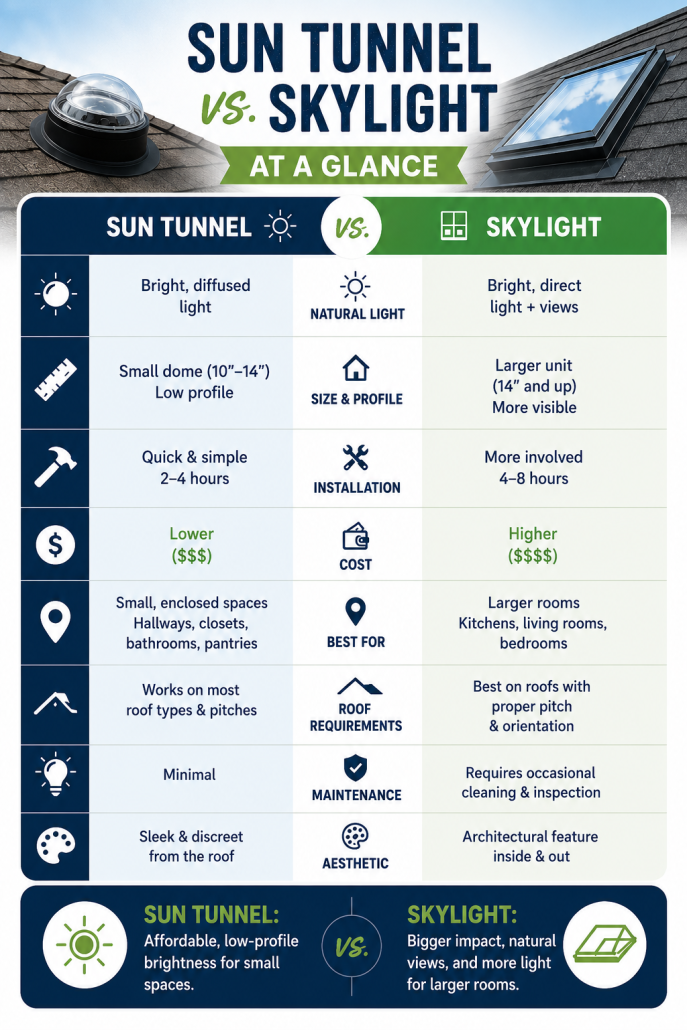
Price matters, so we will be straight with you. A sun tunnel usually lands around half the cost of a skylight, and sometimes even less. The reason is simple: a sun tunnel is far less invasive. We cut a small hole in the roof and the ceiling, attach a tube in the attic, and set the trim and diffuser inside.
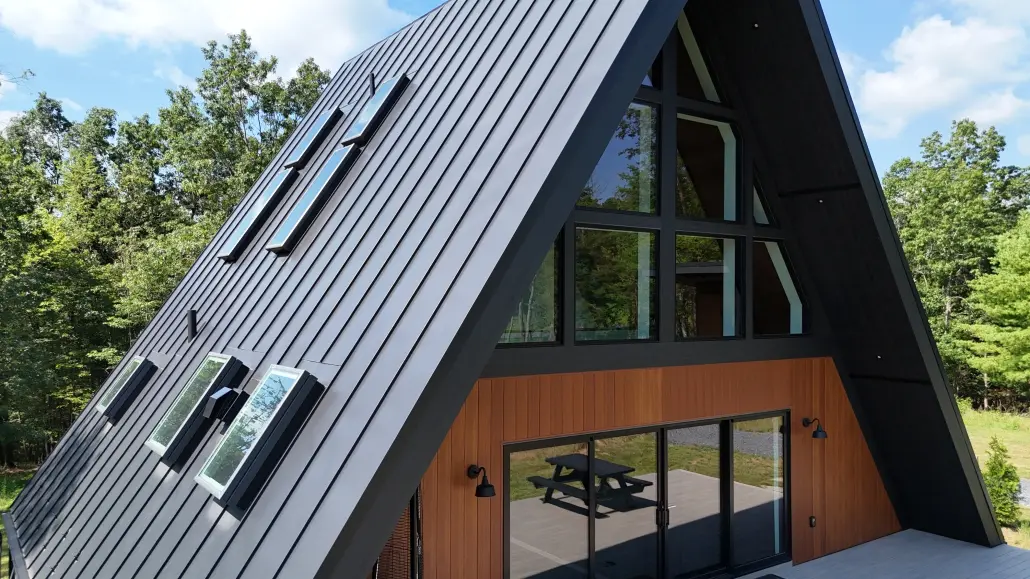
A skylight is a bigger job. Because the opening is large, there is often framing involved, a light shaft to build, and interior finish work to complete.
Nationally, a sun tunnel runs about $1,500 to $2,500 installed, while skylights average roughly $1,600 to $4,200, and a vented “fresh air” model can climb to $3,200 to $5,000, according to HomeGuide’s cost guides. Your real number depends on roof pitch, roof type, rafter spacing, tube run length, and how much drywall and finish work the job needs.
Which lets in more light, and which kind of light do you want?
Both brighten a room, but not in the same way. A skylight lets in more light overall and hands you a sky view, which is wonderful in a living room or kitchen. The trade-off is that a big pane of glass can also bring heat and glare on a hot valley afternoon. A sun tunnel gives you soft, steady, glare-free daylight with less heat gain, but no view of the sky.
So ask yourself what the room is for. A reading nook where you want to watch the clouds leans skylight? A small bath or hallway that just needs to feel bright and cheerful leans sun tunnel?
If we have one regret to warn you about, it is stopping at a single sun tunnel when a second one would have doubled the glow. In this article, the U.S. Department of Energy explains the basics of daylighting.
By light-collecting area, a 14-inch sun tunnel has an opening of roughly 1 square foot, while a standard 2-by-4-foot skylight has about 8 square feet of glazing. That is on the order of 5 to 8 times more collecting surface, so a full-size skylight can realistically deliver several hundred percent more raw daylight than a single sun tunnel.
By practical room coverage, which is how installers actually size these, the gap looks smaller. Velux and most roofers rate a 14-inch sun tunnel to comfortably light about 200 square feet, and a 10-inch for about 100 square feet. A single standard skylight will brighten a considerably larger area and add a sky view on top of it.
Expect a skylight to bring in roughly two to four times the usable daylight of a comparable single sun tunnel, which is why two or three sun tunnels are often suggested to match one skylight in a larger room. Real output then swings with roof orientation (south is best), tube length, season, and shade from trees or roof lines.
Why do people prefer one over the other?
Why do some homeowners lean toward a sun tunnel while others hold out for a skylight? It usually comes down to what the room is really missing. People who choose sun tunnels are chasing brightness, not a view. They have a windowless bath, a dim closet, or a hallway that swallows light, and they want a clean, glare-free glow without a big hole in the roof, a big bill, or a long install. The soft, steady daylight feels natural, the price is friendly, and the small opening gives them peace of mind about leaks.
People who hold out for a skylight are after something a sun tunnel simply cannot give: the view. They want to look up and see sky, clouds, and stars, and they want a wide wash of daylight that makes a whole living room or kitchen feel open and airy. For them, the extra cost and the extra install work are worth it, because the skylight is not just a light source; it is a feature of the room. And when fresh air matters, a vented skylight opens for a breeze, which no sun tunnel can do.
| They tend to prefer a sun tunnel when… | They tend to prefer a skylight when… |
|---|---|
| The room just needs to feel brighter | They want to see the sky, clouds, and stars |
| Budget is tight and they want a fast install | They are willing to invest for a bigger effect |
| Leak worry is top of mind (smaller opening) | They want a wide, dramatic wash of daylight |
| The space is small: bath, closet, hallway | The space is large: living room, kitchen, addition |
| Glare-free, even light is the goal | Fresh-air ventilation matters (vented model) |
| Attic ducts or framing block a bigger opening | The roof and framing allow a clean, safe placement |
Do sun tunnels or skylights leak, and how do you stop it?
Here is the honest answer to your biggest fear: leaks almost always come from bad flashing and bad installation, not from the product itself. A well-flashed Velux unit, installed by a crew that knows valley roofs, keeps water out for years. Because a sun tunnel needs only a small opening, it is generally the lower-risk choice. A skylight depends heavily on a proper flashing kit and a careful installer.
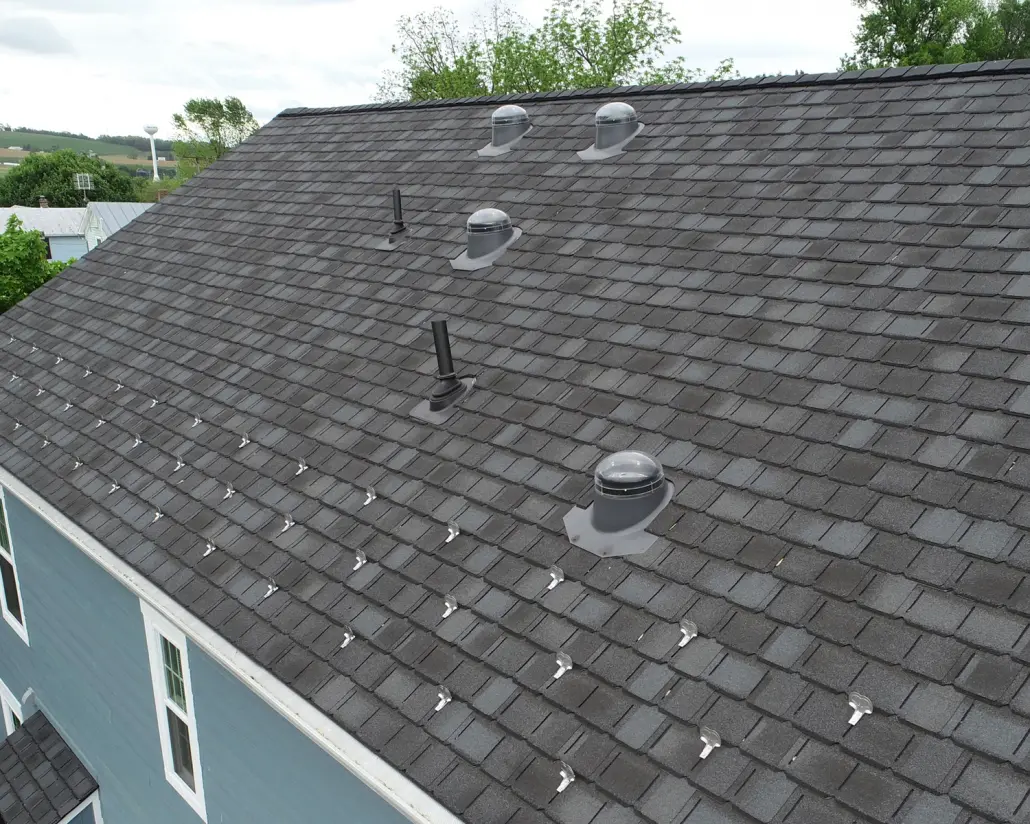
Placement is part of leak prevention, too. We will not put a skylight in a roof valley, because water funnels through valleys and a penetration there is asking to leak. A sun tunnel gives us more room to work: using flexible tubing, we can set the dome higher on the roof, away from trouble, and still bring the light down to exactly where you want it inside.
What makes the Shenandoah Valley different for roof daylighting?
A generic online answer does not know your roof, and the valley is its own animal. Our four real seasons put roofs through summer heat and humidity, winter snow load, and the hail and wind that roll through in storm season. Every one of those stresses a roof penetration and its flashing, so quality matters more here, not less.
Then there are our historic homes. Older valley houses often have steep roofs, slate or metal, plaster ceilings, and framing that is not built to modern standards. Where a skylight can go, and even where a sun tunnel can go, is largely decided by the framing beneath, the trusses, ductwork, and electrical in the attic. This is exactly where the sun tunnel shines: with rigid or flexible tubing, we can route around a duct or a rafter that would stop a skylight cold.
Which should you choose for your room and roof?
Best pick by situation
| Your situation | Better pick | Why |
|---|---|---|
| Dark bathroom, closet, hallway | Sun tunnel | Small opening, soft daylight, lower cost |
| Living room or kitchen wanting a view | Skylight | Sky view, big light, room to feature it |
| Want fresh-air ventilation | Vented skylight | Opens for airflow |
| Tight budget, fast install | Sun tunnel | Less framing and finish work |
| Steep or historic roof | Depends, ask a pro | Framing and flashing get specific |
So, sun tunnel or skylight, what is the smart move for your home?
It comes down to five things:
-
- Light
- View
- Budget
- Room
- Roof
A sun tunnel wins on price and simplicity and is hard to beat for small, dark spaces. A skylight wins on drama, daylight, and that view of the sky. But here is the part that matters most: a clean, leak-free result depends far more on the installer than on the label on the box. The right pick brightens a room you use every single day and protects the roof over your head.
When you are ready for a straight recommendation on your specific roof, book a discovery call with a project consultant. We will tell you honestly which one fits, and when neither one is right.