
What makes metal roofing in the Shenandoah Valley different from other areas?
Metal roofing in the Shenandoah Valley is not just about choosing a material; it is about adapting to the architecture and the weather that create unique challenges.
Older homes throughout the Valley often include multiple chimneys, while newer builds tend to feature skylights and more complex rooflines with dormers. In fact, on our metal roofing projects, roughly 75% include at least one of these features.
Weather adds another layer of complexity:
-
- Ice storms and heavy snow loads are common
- Improper or missing snow guards can cause damage to vents and pipes
- Valleys and roof penetrations must handle increased water flow during storms
- Occasional hail occurs, though metal holds up better than shingles
The recent winter storm revealed a common issue: homes without properly installed snow guards experienced broken vent pipes and damaged roof penetrations due to sliding snow loads.
Metal roofing in this region must handle both complex architectural features and harsh seasonal weather conditions.

What are the two main types of metal roofing systems we install?
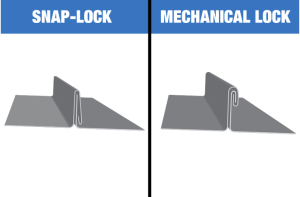
The two primary systems installed are mechanical lock and snap-lock metal roofing. While they may look similar from the ground and the materials are priced similarly, the two perform very differently, especially around roof features.
What is a mechanical lock metal roof?
A mechanical lock system is designed so that metal panels are physically seamed or rolled together, creating a tight, secure bond.
This system is:
-
- More durable under heavy water flow
- Better suited for low-slope roofs down to a 1/12 pitch roof
- More forgiving, therefore easier to adjust the width of panels
- Ideal for areas with valleys, chimneys, and complex transitions, such as a change in roof pitch
- More labor-intensive to install
Because the seams are mechanically closed, this system offers greater long-term protection against water intrusion.
It is important to note that in some historic districts, like Staunton, you cannot use a snap-lock because the ridge caps cannot be visible.
What is a snap-lock metal roof?
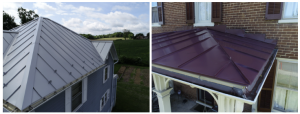
A snap-lock metal roof uses panels that are designed to clip together instead of being mechanically seamed. Each panel is pre-formed at the factory so that one side is fastened to the roof, and the adjacent panel simply snaps over it to create the seam with a friction fit.
This installation method creates wider seams with a slightly raised, beveled appearance, giving the roof a distinct look while also allowing for a faster installation process.
This system is:
-
- Faster to install
- Typically more cost-effective
- Visually distinct with wider, more defined seams
However, it comes with limitations:
-
- Less ideal for complex rooflines
- Only fit a roof with a pitch of at least 3/12
- More challenging for snow guard installation
- Not as strong in high water-flow areas
- Since the panels are narrower, you typically have more material waste
What is an exposed fastener metal roof, and when should it be used?
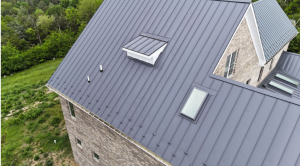
The third type of metal roof is the exposed fastener metal roof, a system where the screws are driven directly through the face of the metal panels, leaving the fasteners visible.
This system is:
-
- Faster and less expensive to install
- Common on barns, garages, and outbuildings
- Simpler in design and installation
However, it comes with important limitations. Because the fasteners are exposed:
-
- They rely on rubber washers that can wear out over time
- They are more prone to loosening, expansion, and contraction issues
- They require more maintenance over the life of the roof
For this reason, at Valley Roofing & Exteriors, exposed fastener metal roofing is only installed on outbuildings that are not conditioned (not heated or cooled).
This system is not recommended for homes or fully insulated living spaces where long-term performance and watertight integrity are critical.
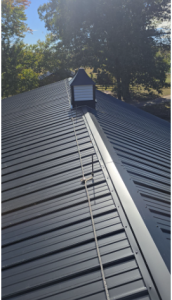
How do you choose the right metal roofing system for your home?
The decision becomes much simpler when broken down by use case:
- If the structure is a home or conditioned space → Mechanical lock or snap lock should be used
- If the roof is complex or low slope → Mechanical lock is typically the better choice
- If the roof is simple and budget is a concern → Snap lock may be sufficient
- If the structure is an unconditioned outbuilding (barn, shed, garage) → Exposed fastener can be a practical option
Choosing the wrong system for the structure, not just the roof, leads to most long-term issues.
| Feature | Mechanical Lock | Snap Lock | Exposed Fastener |
|---|---|---|---|
| Installation | Slower, highly detailed | Faster | Fastest |
| Durability | Highest | Moderate–High | Lower |
| Best for complex roofs | Excellent | Limited | Not suitable |
| Performance in valleys | Strong | Moderate | Weak |
| Fasteners | Hidden | Hidden | Exposed |
| Maintenance | Low | Low | Higher |
| Cost | Higher | Moderate | Lowest |
| Best use case | Homes (complex) | Homes (simple) | Outbuildings only |
What should you do next if you are considering a metal roof?
Metal roofing can perform exceptionally well, even on complex homes, when installed correctly.
If a home includes multiple roof features, then choosing a system designed for complexity becomes critical.
If long-term durability matters, then the focus should shift from just the material to how the system is installed.
If a roof replacement is already planned, then evaluating skylights, chimneys, and dormers at the same time can prevent future issues.
Valley Roofing & Exteriors has worked with homeowners across the Shenandoah Valley on everything from historic homes with multiple chimneys to newer builds with complex rooflines.
To better understand what a properly installed metal roof looks like, the next step is to view the project gallery and see real examples of completed work.
For homeowners ready to move forward, scheduling a discovery call is the best way to evaluate which metal roofing system fits the home and long-term goals.