
By Ben McDorman
Is the low-slope roof over your porch or addition quietly pooling water while you sleep, waiting to leak the moment the next downpour rolls through? If you have stood in the yard, squinting at a flat section of your roof, wondering whether it should wear a rubber membrane or a run of standing-seam metal, you are not alone. The choice feels high-stakes because it is. Pick the wrong material for your pitch, and you invite leaks, stains, and a second bill you never budgeted for.
At Valley Roofing & Exteriors, we have spent 22 years installing flat and low-slope roofs across Central Virginia and the Shenandoah Valley, so we have seen firsthand what lasts and what fails. This guide walks you through how we actually decide between TPO, EPDM, and metal, what each one costs you in lifespan and upkeep, and how our older homes change the answer. We wrote it for the Valley homeowner or property owner who wants a straight answer before the first estimate, not after.
What Makes Low-Slope Roofs Tricky in the Shenandoah Valley?
The Shenandoah Valley throws a lot at a roof. We get heavy rain, wet snow, and long stretches where leaves drift down from mature trees and settle on any surface that will not shed them. Flat and low-slope sections are exactly those surfaces. Add our stock of historic and older homes, many with porches and later additions, and you get roofs that were never one clean, steep plane to begin with. That marriage of weather and architecture is the reason the same material is not right for every project.
How Do We Decide Between TPO, EPDM, and Metal?
When you call us about a flat roof, two questions drive the decision: what is the pitch of the roof, and can you see it? Pitch tells us what is even possible. Visibility tells us what will look right.
A flat roof keeps everything dry, but in our opinion it is not the best-looking roof. A membrane comes in black or white, essentially, and little else. TPO is white; EPDM is black. We can order TPO in other colors, but that requires a large minimum quantity, so it rarely makes sense on the small sections we work on. Metal, by contrast, comes in just about any color you like.
| Cheap Repair | Quality Repair | |
|---|---|---|
| Labor | Unlicensed, unvetted | Licensed, insured crew |
| Diagnosis | Glance from the ground | Attic check to trace the true leak |
| Materials | Whatever is on the truck | Matched shingles, correct flashing |
| Sealing | New shingle left unbonded | Shingle sealed to every neighbor |
| Warranty | None | Written workmanship warranty |
| Lifespan | Months to a year or two | Matches the roof’s remaining life |
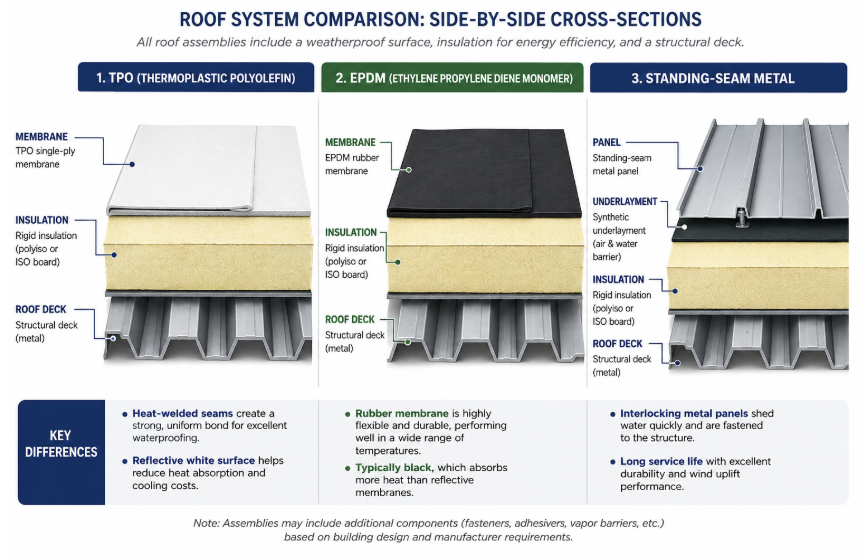
Standing seam metal can go down to a 1:12 pitch, which is the minimum. On a long run with any unevenness, part of that section can dip below 1:12, and that is where trouble starts. So when we see a long cricket or valley funneling a lot of water, we lean toward a flat-roof membrane rather than metal.
| Material | Color options | Minimum pitch | Relative cost |
|---|---|---|---|
| Standing seam metal | Wide variety | 1:12 (at the limit) | Highest |
| TPO membrane | White (others by large order) | True low slope | Lower, near EPDM |
| EPDM membrane | Black | True low slope | Lower, near TPO |
How Long Does Each Roofing Material Last?
Here is the honest lifespan picture, based on what we install and service season after season.
| Material | Typical lifespan | What upkeep looks like |
|---|---|---|
| Metal | 75–100 years | Comes with a 35-year finish warranty; a coat of paint or touch-up after that. As long as the finish holds, it will not rust. |
| TPO membrane | 30–40 years | Keep it clean and clear of debris. |
| EPDM membrane | 20–30 years | Keep it clean and clear of debris. |
Metal is the long-haul champion. The Metal Roofing Alliance tracks the same ranges we see in the field, and after the first 35 to 40 years, the only real task is a little paint.
Why Does Installation Matter More Than the Material You Pick?
Here is the truth we come back to on every job: the material on the label means little if the install is rushed. Most of the lifespan figures you find online are accurate, but only when the roof goes down right. That is the quiet catch behind the numbers.
There are many ways to install metal and flat roofing, and just as many ways to cut corners so a job looks great on the front end and costs less on paper. Lay metal over old shingles, skip proper attic ventilation, or shortcut the seams, and a product built to last 30 years may only give you 15.
So when a cheaper bid lands in your inbox, ask what is being left out, because the savings today often become a second roof tomorrow. Done right, those lifespan numbers hold. Done cheap, they do not.

Which Flat Roof Is Better for Energy Bills?
Most energy questions we field compare metal versus shingles, not flat versus metal. In general, a flat-roof membrane EPDM or TPO section runs a little more efficiently, because when we build it up from a shingle or metal section, we actually add insulation underneath. Metal does not require that insulation, so the finished flat roof lands a touch higher on R-value (the measure of how well a material resists heat flow). If reflectivity is your priority, white TPO is engineered to bounce sunlight rather than soak it up, which is why it qualifies as a cool roof according to ENERGY STAR.
What Is the Maintenance Reality for Each One?
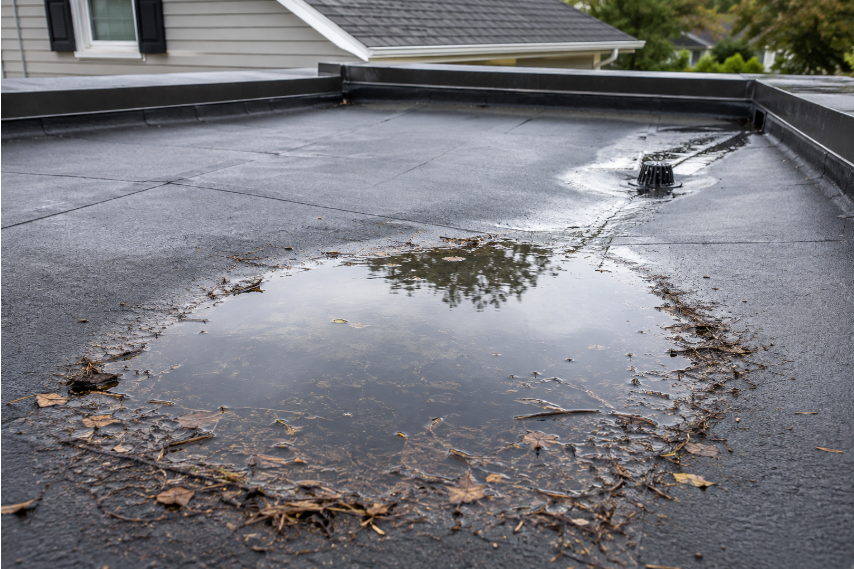
The biggest job on any low-slope roof is to keep it clean. Leaves and debris pile up because a flat surface has nothing to wash them away (pictured).
A TPO membrane carries a 48-hour tolerance for standing water, so if you spot puddles after a storm and they evaporate within two days, you have nothing to worry about. A membrane could essentially hold water like a pool liner, which is hard on the structure over time but not an instant leak.
Metal is the opposite animal. You do not want to see standing water on it at all, because it will eventually leak. On our lowest metal slopes, 1:12 to 2:12, we seal the seams, because without that sealant, water can wick right through them. A metal rib is simply not built to hold a puddle.
| Material | Standing water tolerance | Watch for |
|---|---|---|
| TPO | Up to 48 hours | Trapped debris that holds water can stain the surface |
| EPDM | Keep clear, do not let water sit | Glued seams; keep debris off |
| Metal | None | Sealed seams on low slopes; debris holds water where you do not want it |
How Do Older or Historic Homes Change the Answer?
Older homes in the Shenandoah Valley tend to complicate the picture, but that is where our experience comes in. On a historic house, a low-slope area is often a front porch you can see from the street. There we usually leave standing seam metal, because it looks right and reads as part of the home.
Older homes also tend to carry additions built years after the original structure, and those additions create crickets: low-slope pockets tucked between two steep faces. In those pockets, we lean toward a TPO or EPDM membrane. We avoid tying metal into TPO for a good reason. A metal roof is built to last 75 to 100 years, but the membrane it would tie into lasts 40 years at best. Marry the two, and in 40 years you must tear out and reconnect the flat section without disturbing metal that still has decades left. That is a headache we would rather design around from the start.
What Is the Real Difference Between TPO and EPDM?
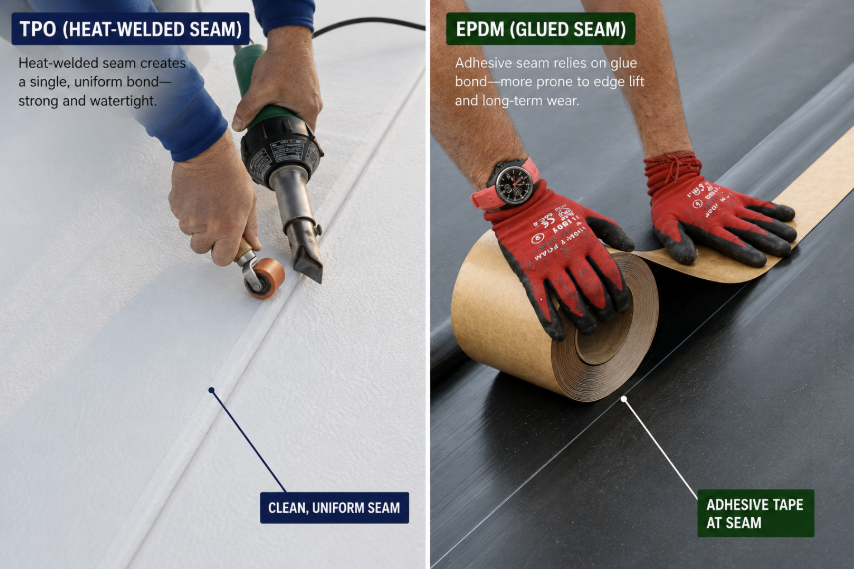
If you have narrowed it to the two membranes, the core difference is how the seams come together. TPO seams are heat-welded, so once the sheet is joined, it behaves as basically one bonded piece. EPDM seams are glued. There are ways to mechanically attach EPDM, but the system leans on adhesive to bring it all together. Our TPO uses a RhinoBond system, which means we fasten the field without gluing it down. That detail matters to a specific buyer: folks who care about energy bills often care about chemicals and VOCs too, and hot-air-welded TPO skips the glues and solvents an EPDM install relies on. For some homeowners, that is the deciding factor; for others it never comes up.
So Which Flat Roof Should You Choose?
The short version: pitch and visibility point the way, then lifespan, upkeep, and your home’s age fine-tune it. Metal rewards you with 75 to 100 years and rich color where slope and sightlines allow. TPO and EPDM protect the true low-slope pockets metal cannot, with TPO edging ahead on welded seams and a cleaner, chemical-light install.
None of it matters, though, if the work is rushed, because installation is what turns those lifespan numbers real.
Want to see what done-right looks like? Browse our project gallery. When you’re ready, book a discovery call with a Valley Roofing project consultant, and we will match the right material to your roof, your pitch, and your home.