

When was the last time you dared to poke your head into that dark, dusty attic above you? For many homeowners, the honest answer is “never.” It is easy to shut the hatch and forget the space exists. But here is the uncomfortable truth: your attic is often the very first place a failing roof cries for help, long before a stain appears on your ceiling.
At Valley Roofing & Exteriors, we have spent more than 22 years climbing into attics all across the Shenandoah Valley, and we have learned to trust what that space is trying to tell us.
This post is for the homeowner who wants to catch trouble early and skip the sinking feeling of a surprise repair. We will walk you through the warning signs we see almost every day, which ones are true emergencies, and a simple twice-a-year checklist you can actually follow. No fluff, no scare tactics, just what we know to be true from being up there ourselves.
What Makes Roofs in the Shenandoah Valley Age Differently?
The Valley is a beautiful place to own a home, and yet a demanding place for a roof. We have hot, humid summers, cold winters, and a whole lot of history. Many homes here have had a roof put on, torn off, and replaced two, three, sometimes even four times over the decades. Every time a new roof goes on the same old wood, that decking gets a little more worn, brittle, and tired.
We also cover a lot of wooded ground. From Harrisonburg to Staunton to Waynesboro, we find closed-off attics, worn roof decks, and critters looking for a warm place to live. That mix of old homes, humid air, and heavy tree cover is exactly why the attic matters so much around here. What looks fine from the street can be a very different story once you climb inside.
What Is the Most Common Attic Warning Sign We See?
If we had to name the single biggest problem we find, it would be inadequate ventilation. It is not dramatic, and it is easy to miss, but it quietly shortens the life of more roofs than almost anything else. The simple story is this: the air is not moving correctly.
Your attic is designed to run hotter than your living space. But what we do not want to see is stagnant air, where the heat just sits and builds with nowhere to go. A closed-off attic can climb well past 150 degrees, and we have measured readings north of 170. The U.S. Department of Energy lists proper attic airflow among the most cost-effective ways to protect a home. That trapped heat bakes the roof from the inside, drying out the shingles and breaking down decking year after year. The result is premature aging.
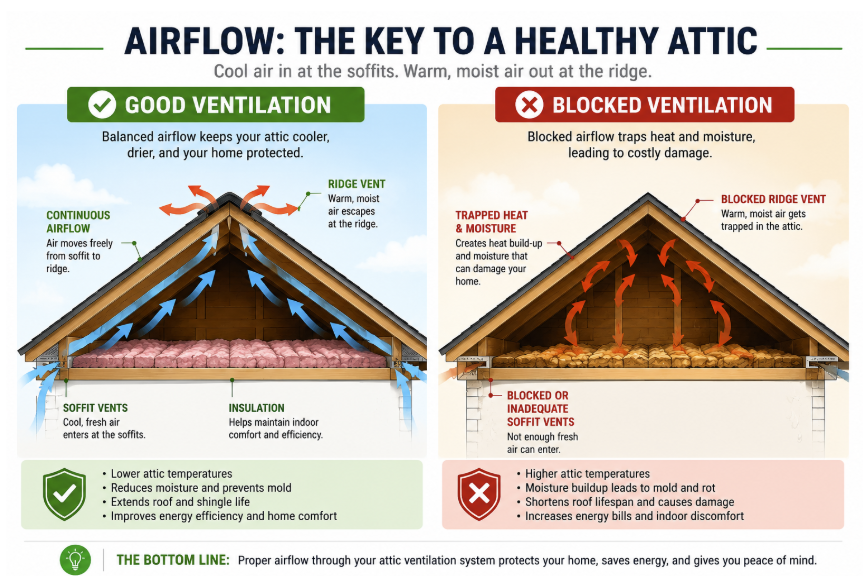
Stagnant air brings a second problem. When air sits still, moisture has nowhere to escape, and you get mold and mildew. That is unhealthy for your family, and the mildew can break down the plywood decking just as the heat does. The moment we poke our heads into a poorly vented attic, we usually know. It is pitch dark, with a musty, mildewy smell that gives it away.
Another telltale sign of excessive heat buildup is warped or buckled plywood. The glue in the layers of plywood gets too hot and begins to loosen.
Which Attic Warning Signs Are True Emergencies?
Some things can wait for your next inspection. Others mean you should call us right away. The difference usually comes down to active moisture. Once water starts moving where it should not be, the rot spreads like cancer, and a small fix turns into a big one.
Here are the signs we treat as urgent:
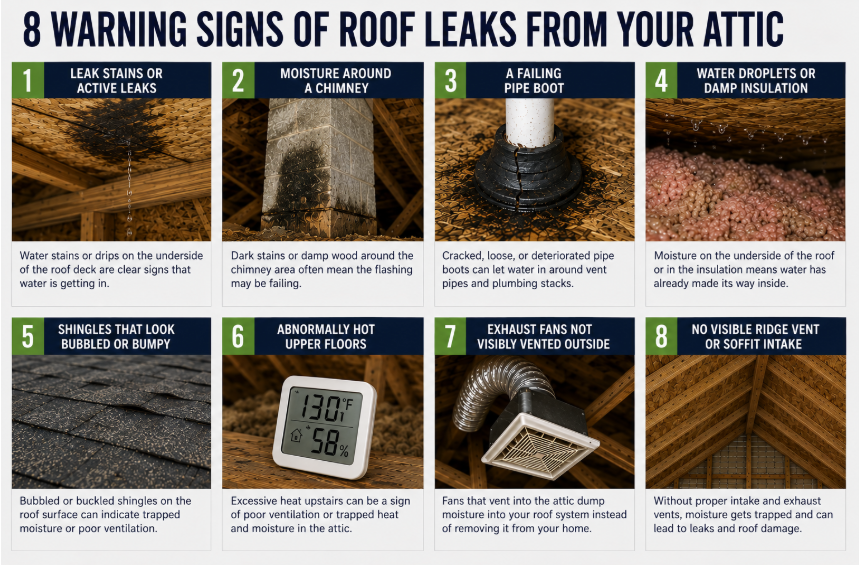
| Warning sign | What it usually means | How urgent |
| Leak stains or active leaks | Water is getting past the roof, sometimes rotting the overhang before it ever shows inside the house | Call immediately |
| Moisture around a chimney | Water on the masonry or the decking near the chimney can rot structural wood fast | Call immediately |
| A failing pipe boot | A pipe is sealed with a rubber gasket, and that gasket is one of the first things to fail on any roof | Call soon |
| Water droplets or damp insulation | The roof can look fine on top, but moisture in the insulation tells the real story | Call soon |
| Shingles that look bubbled up or bumpy | Trapped heat and moisture are pushing up from below, a sign the decking is swelling or the shingles are breaking down early | Call soon |
| Abnormally hot temperature on upper floors | The attic heat is more than a standard HVAC system can manage, usually pointing to poor ventilation | Call soon |
| Exhaust fans not visibly vented | Range hoods or bathroom fans are dumping warm, moist air into the attic instead of pushing it out through the roof | Call soon |
| No visible ridge vent or soffit intake | The attic has no real way to bring air in or let it out, so heat and moisture sit and build with nowhere to go | Call soon |
The overhang leak is a sneaky one. You can have water breaking down the wood on the overhang, completely rotting it out, while you never see a single drop inside the house. The attic is the only place that it shows up.

When Is It a Repair, and When Is It a Replacement?
This is the question everyone wants answered, and we will be honest with you: it is a little hard to draw a clean line. It depends on how much damage is inside the attic and how old the roof already is.
The biggest factor is time. We have walked into attics where a homeowner knew about a leak, set a bucket under the drip, and just let it do its thing for years. That is the worst thing you can do. The rot spreads, and what could have been a simple, affordable fix early on becomes a worn-out roof we can no longer patch. When the decking is rotted, and the roof is spent, replacement becomes the smarter, safer choice.
When we do climb up for a replacement, one of the first things we check is whether the wood underneath is still structurally sound enough to hold a new roof. On those historic homes with three or four layers of roofing, that wood can be too brittle to trust.
What Should You Check in Your Attic Twice a Year?
You do not need to be an expert to do a once-over. A couple of times a year, grab a flashlight and look for the small signs of a slow leak, especially the kind that never shows up inside the house.
| Spot to check | What to look for |
| Insulation surface | Little dimples where water droplets have landed, a dead giveaway of a slow leak |
| Under and around pipes | Damp spots or staining where a rubber boot has started to fail |
| Around chimneys and skylights | Moisture, discoloration, or a musty smell |
| Along the ridge | Staining under an older ridge vent that may be leaking |
One friendly warning: you may not be alone up there. Attics stay warm, and snakes and squirrels love them. Squirrels in particular will chew right through a soffit or any little opening to get in, especially in wooded areas. If crawling around up there is not your idea of a good time, that is exactly what we are for.
How Do Insulation and Baffles Affect Your Roof?
Ventilation and insulation are two sides of the same coin. Over the years, many homeowners add blown-in insulation to save on energy bills. That is a good thing, but there is a right way to do it. If the insulation gets pushed out into the overhangs and covers the soffit vents, it chokes off the airflow and creates the stagnant-air problem we warned about.
The fix is a simple part called a baffle, a small piece of Styrofoam that keeps the insulation from touching the roof deck. Air is designed to come in through the overhang, travel free and clear up into the attic, and vent out the ridge. A baffle protects that path. It is a tiny piece with a big job. This is also why we inspect every attic before we quote a roof: to spot spray foam on the underside of the deck, to protect any family heirlooms stored up there from falling grit and granules, and to design a system that works with your home instead of against it.
Is Your Attic Trying to Tell You Something?
Your attic is quieter than a dripping ceiling, but it speaks a lot sooner. Trapped heat, stagnant air, a musty smell, a dimple in the insulation, or a soft spot near the chimney are all early warnings that your roof needs attention. The homeowners who listen early are the ones who catch a cheap repair instead of paying for a full replacement.
If you would like to see what quality work looks like, take a few minutes to browse our project gallery. And when you are ready for a real answer about your own roof, schedule a free inspection with one of our project consultants. We will climb into that dark, dusty space so you do not have to, and we will tell you honestly what we find.