

What if the gutters you just paid good money for are quietly pouring water straight into your foundation?
It is not a comfortable question; in fact, it is downright frustrating. And most homeowners cannot answer it on their own. You cannot stand on a ladder supervising every screw, and a cut corner hides well behind a clean-looking finished job, right up until the first hard storm or heavy snow.
At Valley Roofing & Exteriors, with our 22 years working on Shenandoah Valley homes, we know not every homeowner is going to choose us. And that is okay. You deserve quality work no matter who you hire.
In this article, we are laying out the most common gutter installation shortcuts we find on homes across Central Virginia, the signs that give them away, and the exact questions to ask any contractor before you sign anything.
Why Do Gutters Fail Faster in the Shenandoah Valley?
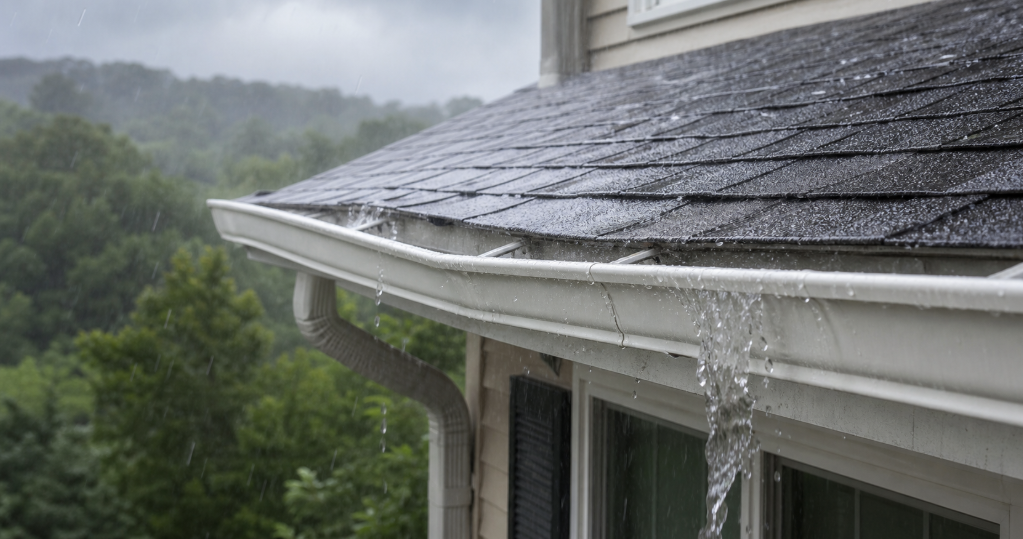
The Valley sits in a rain shadow and averages about 33 inches of rain a year, well below Virginia’s 43-inch state average. That number fools people into thinking gutters matter less here. The opposite is true: our rain tends to arrive in hard, fast storms that overwhelm undersized or poorly hung gutters all at once. Add freeze-thaw winters that expand and contract metal, load gutters with snow and ice, and work fasteners loose, and a shortcut install gets exposed here sooner than almost anywhere else in the state.
What Are the Most Common Gutter Installation Shortcuts?
Too Few Hangers, Spaced Too Far Apart
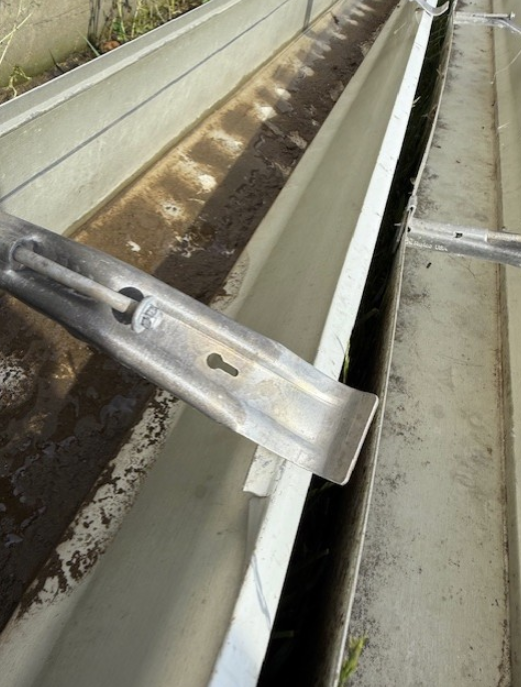
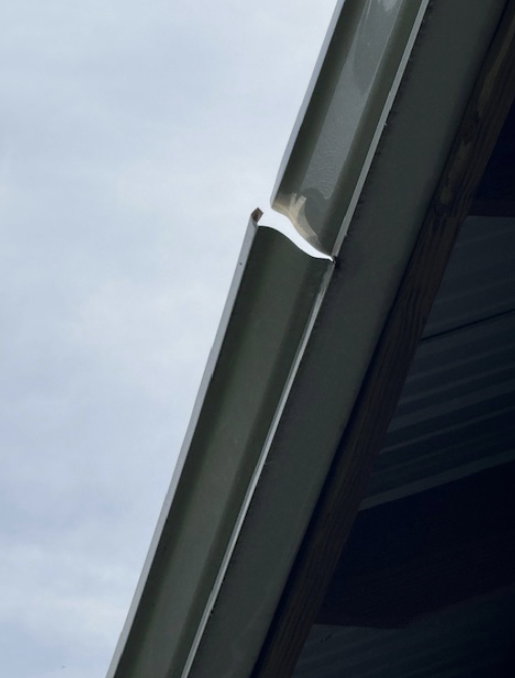
This is the single most prevalent shortcut we see in the Valley, and it is almost always a cost-saving move. Hangers are what carry the entire weight of the gutter, plus every pound of water, snow, and ice that lands in it. When a crew stretches the spacing to save a few dollars in hardware, the gutter cannot stand up to that force. It sags, pulls away from the fascia, and eventually the homeowner is forced to replace the whole system.
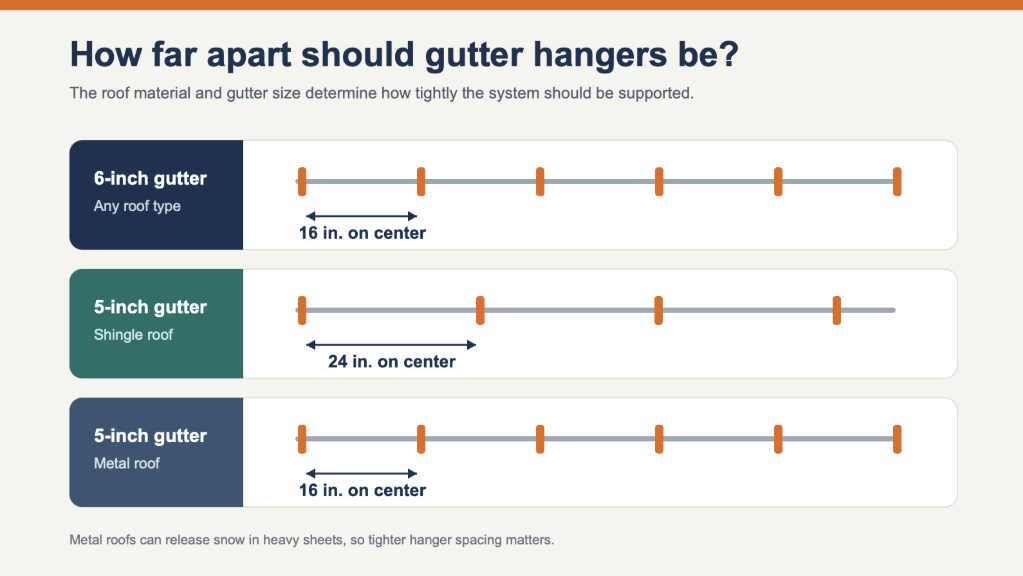
Done right, the numbers are specific. On our installs, we use Hang Fast hangers from Raytec, an extremely strong hidden hanger, and we space them based on the gutter and the roof above it. Every 6-inch gutter gets hangers at 16 inches on center. A 5-inch gutter under shingle roofing gets 24-inch spacing, but if that same 5-inch gutter sits under a metal roof, where snow releases in heavy sheets, we tighten back up to 16 inches. Ask your installer for specific numbers. If the answer is vague, that tells you something.
Spikes Instead of Hidden Hangers
Spike-and-ferrule fastening is older technology; it aged out generations ago. Spikes work loose through freeze-thaw cycles, leave visible nail heads across the face of the gutter, and give the system far less grip on the house. In contrast, hidden hangers screw into the fascia, hold dramatically more weight, and are invisible. There is no good reason to see spikes on a new install today.
Sectional Instead of Seamless
Every section is one more point that could leak. That is why we run seamless gutters on-site rather than piecing together sectional runs. A seam that holds on day one still has years of expansion, contraction, and debris ahead of it. Seamless eliminates those failure points before they exist.
Getting the Slope Wrong, or Ignoring It Entirely
Walk up to some houses, and you can see the gutter sloping the wrong direction, or simply slapped wherever the installer thought it looked right. We do not treat slope as an afterthought, but we also do not chase a rigid formula. The standard that matters is a balance of aesthetics and functionality: the gutter should carry water decisively to the downspout while still looking straight and intentional on the home. If water reaches the downspout and drains, the slope is doing its job. If it pools mid-run, it is not.
Too Few or Undersized Downspouts
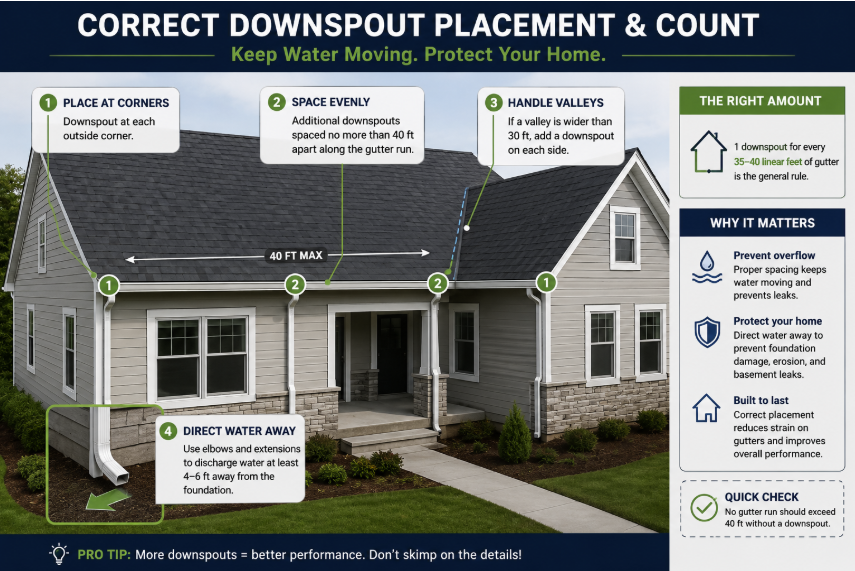
Downspouts belong on the downhill side of the home, or tied into underground drains where they exist.
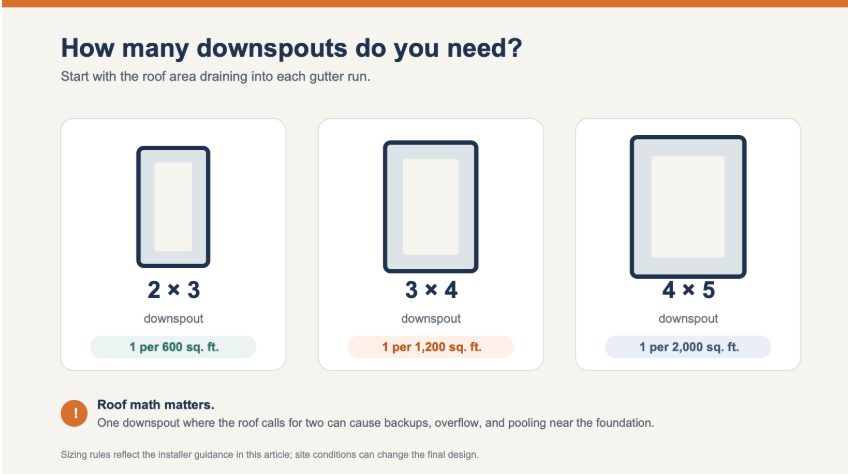
Sizing comes down to roof area. Figure one 2×3 downspout for every 600 square feet of roof, one 3×4 for every 1,200 square feet, and one 4×5, mostly a commercial and agricultural size, for every 2,000 square feet. Most residential homes run 2×3 downspouts, but larger homes with 6-inch gutters often step up to a 3×4 so more water can flow through. A crew that installs one downspout where the roof math calls for two is setting up backups and foundation pooling.
What About Older and Historic Homes?
Almost all of the historic districts around here require half-round gutters, and aesthetically they are beautiful on those homes. The honest trade-off is capacity: half-round simply does not carry as much water as the K-style profile we typically install. That does not make half-round a bad choice; we do plenty of half-round jobs that perform well, but it makes correct downspout sizing and hanger spacing even more important, because there is less margin for error.
A Real Fix: Singers Glen
We recently redid an agricultural building in Singers Glen where the original install had come down under snow load. Two shortcuts stacked on top of each other: the hanger spacing was too wide, and the aluminum coil was 0.027-inch thick, whereas an agricultural building of that size needs 0.032-inch. Neither decision looked wrong from the ground. Together, they meant the system could not carry the first serious snow. The homeowner paid for the job twice, which is exactly what shortcuts cost.
How Can You Spot Trouble From the Ground?
You do not need a ladder. Look:
- For sagging anywhere along the run.
- For a gutter that visibly slopes away from its downspout.
- Underneath the gutter, beside the foundation, check for a streak or strip in the soil or mulch. That line means water is overflowing the gutter and landing where it does the most damage.
Properly installed gutters are critical to protecting your home’s foundation; this is as much a foundation issue as a gutter issue. Before any big storm, take two minutes to confirm your downspouts are not clogged.
What Should You Ask Before You Hire a Gutter Installer?
Four questions will flush out most shortcuts.
- What hanger will you be using, and how far apart?
- Should my home have 5-inch or 6-inch gutters?
- What size downspouts, and how many, based on my roof area?
- Can you get a color compatible with my home?
A quality contractor answers all four with specifics, immediately.
If your gutters were installed before you owned the home, or you are simply not sure what is holding them up, we are happy to take a look before the next storm season does it for you.
Check out the top gutter companies in your neighborhood– Harrisonburg, Charlottesville, and Staunton. And when you’re ready, browse our project gallery to see what quality work looks like, or book a call with a Valley Roofing project consultant.