
Why Does the Shenandoah Valley Climate Wreck Decks Faster Than Most Regions?
Harrisonburg, Charlottesville, Staunton, and Lexington climates are not kind to exterior wood. Humid summers accelerate mold and rot. Winter freeze-thaw cycles force moisture into every crack, splitting boards from the inside out.
Heavy pollen seasons coat surfaces and hold moisture against the grain. And west-facing decks take a beating from intense afternoon UV that bleaches and dries out wood faster than shaded north-side decks ever will.
Add in the fact that many Valley homes are 80 to 150 years old, where a deck has to look right against original stone, brick, or historic siding, and the material choice gets even more precise.
Microclimates matter here, too. A deck on a home tucked against the mountain’s east side dries at a very different rate than one sitting in open sun on the western slope.
This climate is exactly why longevity, cost, and maintenance separate the three materials so sharply. Each one handles Valley moisture, freeze-thaw, and UV in a fundamentally different way, and that difference compounds over the life of the deck.
A quick material overview:
| Material | Core | Typical Lifespan |
|---|---|---|
| Pressure-Treated Pine | Softwood + chemical treatment | 10–15 years |
| Cedar | Naturally rot-resistant softwood | 15–20 years |
| Capped Composite | Wood fiber + recycled plastic, polymer shell | 25–30 years |
| PVC | 100% plastic, no wood content | 30–50+ years |
Cedar and redwood are not commonly available in this region; pressure-treated pine is the default wood option regionally. For homeowners who want real wood at the high end, tropical hardwoods (ipe, mahogany) or thermally modified oak are the premium choices.
Longevity: How Long Does Each Material Last Here?
This is where the Valley climate does its sorting, and where the three materials are furthest apart.
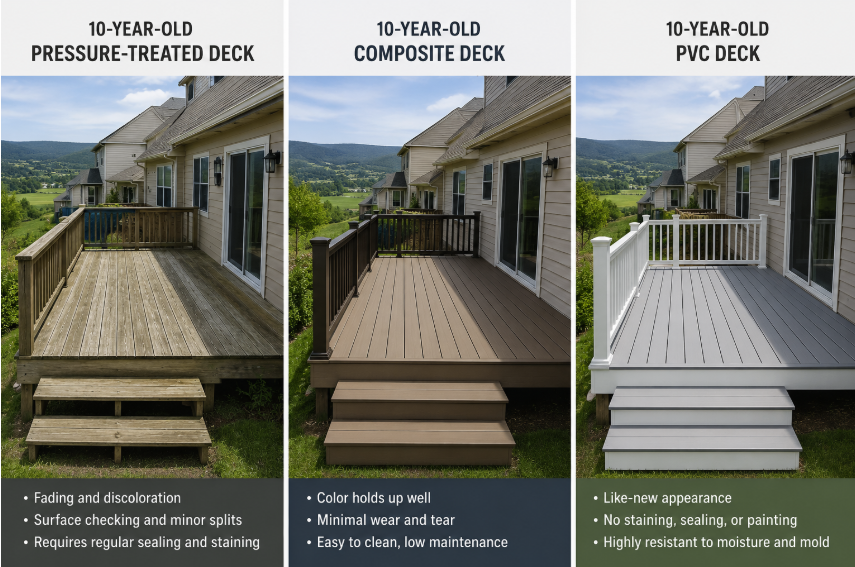
Wood fails the quickest. Rot, warping, cracking, UV fading, that is simply the aging process of pressure-treated pine. By the time wood is 15 years old, it will be full of cracks and starting to rot. Cedar buys you a few more years, but it is hard to find here, and still has a finite clock.
Composite tells a different story. On first-generation boards, the ones installed in the early 2000s that are still on many Valley decks, UV exposure would break down the outer coating over time.
But modern capped composite is far more durable. We have replaced only a handful of composite deck boards over the years due to natural causes. The more common failure we see is not the material at all, it is improper installation, usually boards spaced too tightly, which causes early buckling. Done right, capped composite reliably reaches 25 to 30 years.
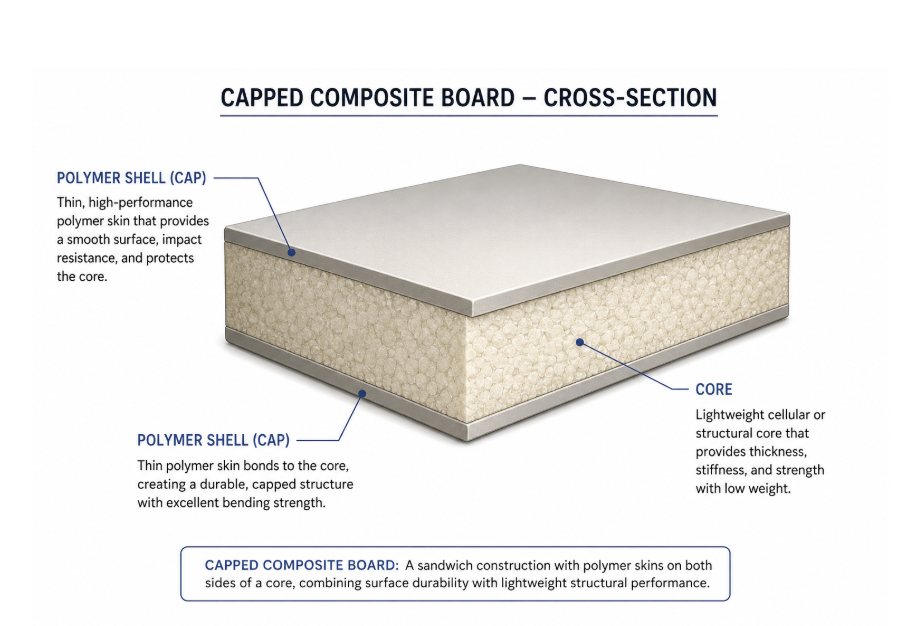
PVC fails the least of the three, because there is no wood component for moisture to attack. It does not rot, it does not feed mildew the way wood fiber can, and it shrugs off the freeze-thaw cycles that split pine. When PVC does have a problem in this climate, it is almost always thermal: a 100 percent plastic board expands and contracts more with temperature swings than composite does, so a poor install, boards butted too tight or fasteners set wrong, can lead to movement, gapping, or noise. Done correctly, PVC is the most weather-proof surface we install, with a 30-to-50+ year life. Early dark-colored PVC could also show surface fading under intense afternoon UV, though modern capped formulations have largely solved this.
Longevity verdict: PVC lasts longest, capped composite is close behind, and wood trails well back — often needing a full rebuild while the other two are barely middle-aged.
Cost: What Does the 10-to-30-Year Picture Actually Look Like?
Here is something most homeowners do not know: pressure-treated wood prices jumped significantly during COVID and have not fully come back down. Composite board prices, meanwhile, have stayed roughly flat for the past decade. The gap between wood and composite is much smaller than it used to be. PVC sits at the top; it is the highest upfront cost of the three, but it is also the longest-lived.
Our rule of thumb: by the time you have paid someone to stain a wood deck twice, you have basically paid the same price as composite upfront.
Over a 25-to-30-year window, a fairer comparison, since composite and PVC are both still going strong when a wood deck is on its second full replacement, the numbers flip:
-
- Wood (pressure-treated): approximately $200 per square foot in total lifetime cost, because you are rebuilding it twice and staining it roughly every five years, about five times over that span
- Composite: approximately $100 per square foot in total lifetime cost
- PVC: higher upfront than composite, but comparable lifetime cost over 30-plus years, and the gap narrows further on a 40-to-50-year horizon, because the board may never need replacing
The upfront cost of composite and PVC is higher. The lifetime cost is not. Wood looks cheap on installation day and turns out to be the most expensive material once you count rebuilds and stain. PVC asks for the most money on day one and gives back the longest service life with the least maintenance. Review this Consumer Reports Decking Ratings report for an in-depth cost comparison.
Cost verdict: Wood wins the day-one quote and loses the decade. Composite is the lifetime value leader, with PVC close behind and pulling ahead the longer you stay in the home.

Maintenance: How Many Saturdays Does Each Deck Material Ask For?
Wood: Plan on power washing every year and re-staining every three to five years. Some homeowners use Australian oil instead of a standard stain, which requires annual application. Either way, it is a Saturday project, a real commitment of time and money, even more so if you are paying a professional to do it.
Composite: An annual power wash handles most of it. Shaded north-side decks should be checked for mildew. Fasteners and flashing should be inspected yearly.
PVC: The lowest-maintenance surface of the three. An occasional rinse or power wash is all it asks, and because there is no wood fiber in the board, mildew has far less to feed on, even on shaded north-side decks. Fasteners and flashing still deserve a yearly check, the same as any deck.
Annual maintenance hours (approximate):
| Task | Cleaning | Sealing / Staining | Board Replacement | Inspection |
|---|---|---|---|---|
| Wood | 3–4 hours | 8–10 hours (every 2–3 years) | 1–2 hours | 1 hour |
| Composite | 1–2 hours | 0 | 0–1 hours | 1 hour |
| PVC | 1 hour | 0 | 0 hours | 1 hour |
In 22 years, we have seen few, if any, customers switch from composite back to wood. But we have seen countless wood deck owners switch to PVC. It is always the maintenance. They are tired of staining it. They want a deck that is going to last a longer time.
Maintenance verdict: PVC asks for the least, composite is nearly as easy, and wood is in a category of its own, a recurring chore for the life of the deck.
One Myth Worth Clearing Up
Composite and PVC decking look smooth and finished, and some homeowners assume they must be slippery. However, in our opinion, wood is more dangerous when it is wet than composite or PVC deck boards are. Weathered, wet wood, especially in the shade, is the real slip hazard. Most composite and PVC boards are made with an embossed or textured surface that holds traction well, even in Valley rain.
Which Material Is Right for Your Home?
Longevity, cost, and maintenance point most homeowners toward composite or PVC, but the right fit depends on your home and how you live. A few scenarios:
-
- Historic farmhouse on the National Register? Real wood often reads more authentic against original siding and stone.
- Deck in full afternoon sun off a south- or west-facing wall? A light-colored capped composite or PVC handles surface heat better than a dark wood board.
- Household with barefoot kids, dogs, or frequent travel? Composite and PVC win on lifestyle, no splinters, no annual staining over the weekend, no rot surprises while out of town.
- Building once and never wanting to think about it again? PVC offers the longest lifespan and the least maintenance of any option, which is why we point homeowners playing the long game toward it.
- Tight budget today, and you enjoy spring projects? Pressure-treated wood done right can serve well for a decade-plus.
Read more about your options here.
So, Which Decking Material Wins for Your Virginia Home?
There is no universally wrong choice, only a wrong fit. Measured on the three things that matter, longevity, cost, and maintenance, each material has a clear strength and a clear trade-off.
Wood offers the lowest upfront cost, an authentic look for historic homes, and easy spot repairs. The drawbacks are real, though: the shortest life of the three, the most upkeep by far, and a lifetime cost that ends up the highest once you count the rebuilds and the staining.
Composite offers dramatically lower lifetime cost, minimal maintenance, and strong performance through Valley summers and winters. The drawbacks are a higher upfront price than wood, and the fact that it lives or dies by the install; boards spaced too tightly will buckle early, so workmanship matters more than with wood.
PVC takes both longevity and low maintenance the furthest of the three, for homeowners who want to build once and never look back. Its drawbacks are the highest upfront price of any option, more thermal movement than composite (which again makes a correct install critical), and a slightly less convincing wood look up close.
The right answer depends on your home’s character, your lifestyle, and how you want to spend your Saturday mornings ten years from now.
Treat this guide as your starting point. When you sit down with any contractor, including us, insist on written documentation of licensing, insurance, manufacturer certification, and warranty terms. Compare estimates line by line and ask about anything left vague. A trustworthy contractor will welcome those questions.
Valley Roofing & Exteriors has installed skylights across this valley for more than twenty years, and we are confident in what we bring to a project. But the purpose of this article is not to win your job. It is to make sure that whoever ends up on your roof deserves to be there.
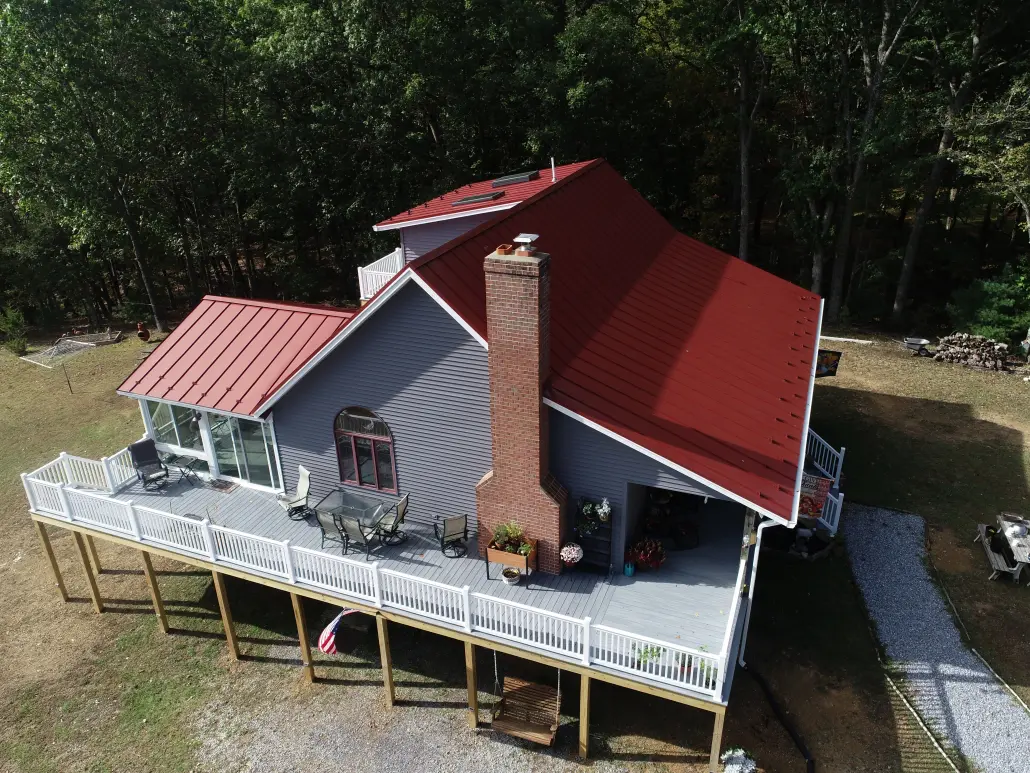
Want to see the three materials on real Valley homes? View our project gallery.
Excited to talk through your specific project? Book a no-pressure consultation with a Valley Roofing & Exteriors project consultant, and we will walk your site, weigh your options, and recommend the right material for your lifestyle.