

Why Is Storm Damage Different in the Shenandoah Valley?
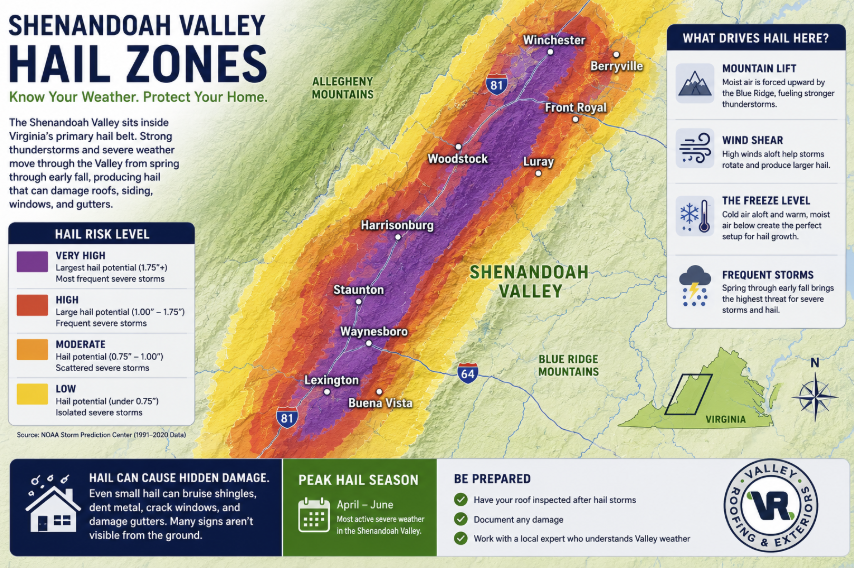
The Valley is its own animal. Wind accelerates off the Blue Ridge and Allegheny ridge lines, the I-81 corridor sits in a known hail lane, and late-spring derechos are not rare.
In 2024, we lived through one of those days in early Spring. Sustained 50-mph wind ran from sunup to sundown, the air was bone-dry, brush fires broke out across the region, and our old shop pressurized so hard through the open bay doors we had to muscle them shut. The next day, the forecast called for two inches of rain. That is what we mean by storm response, racing weather, not just repairing damage.
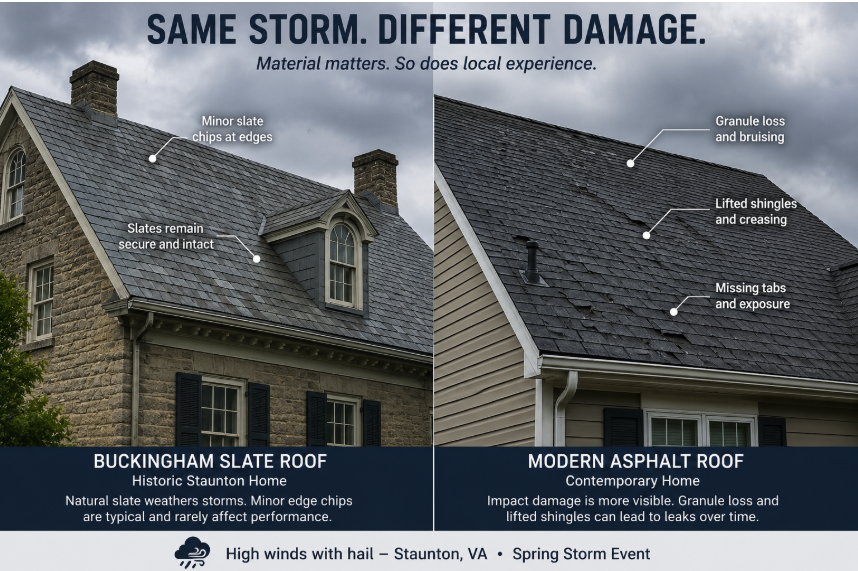
Add in the housing stock. Many historic homes in Staunton, Lexington, Harrisonburg, and Winchester still wear original Buckingham slate, standing-seam metal, or cedar shake. Each material reacts to wind and hail completely differently. Generic advice is not going to help you.
| Storm Type | Typical Months | Most Common Damage | First Thing to Look At |
|---|---|---|---|
| High wind / derecho | March – June | Lifted or torn shingles, missing ridge cap | Driveway and yard for shingle pieces |
| Hail | April – June | Bruised shingles, dented soft metal | Downspouts, vents, chimney flashing |
| Ice and snow load | December – February | Ice dams, fastener fatigue | Attic for water staining, exterior ice dams, and interior water stains |
| Fallen tree or limb | Year-round | Punctures, structural sag | Tree limbs or branches on roof, exterior damage |
To foresee storms in our region, we use the NOAA Storm Events Database and the Virginia Bureau of Insurance consumer alerts.

What Should You Do in the First 24 Hours After a Storm?
Here is your first 24-hour checklist:
| Hour Range | Action | Why It Matters |
|---|---|---|
| 0–2 hours | Check for injuries, gas smells, and downed lines | Safety first, always |
| 2–6 hours | Photograph damage from the ground and the attic | Time-stamped proof for the adjuster |
| 6–12 hours | Call your insurance company and open a claim number | Locks in the date of loss |
| 12–24 hours | Call a local, licensed roofer for an inspection | Gets you in the queue before the rush |
Stay safe and stay off the roof. Power lines, soaked decking, and a hidden structural sag turn a quick look into an ER visit fast. Walk the perimeter from the ground, take time-stamped photos and video before you touch anything, and check the attic with a flashlight for daylight or wet insulation.
If water is actively coming in, a basic interior catch, such as a bucket, a tarp on the floor, or towels, does not hurt your claim. Patching the roof yourself can. And please do not let the first stranger who knocks climb up there either. We will explain why in a minute.
What Are the 7 Steps Valley Roofing & Exteriors Takes After a Storm?
We take storm response seriously, and our process reflects that. When a real event hits the Valley, we watch it in real time and get ahead of the call volume.
When the damage in a community is obvious, we run a “straight-to-order” track, which means we skip the sales process, get production crews rolling, and at minimum get the roof “dried in”, which means temporarily sealed, with underlayment so the next day’s rain does not finish what the wind started.
-
- Free storm inspection within 24 to 48 hours. A trained Valley Roofing & Exteriors crew member gets on the roof. We do not rely on a drone alone; most consumer drones cannot see what the naked eye can.
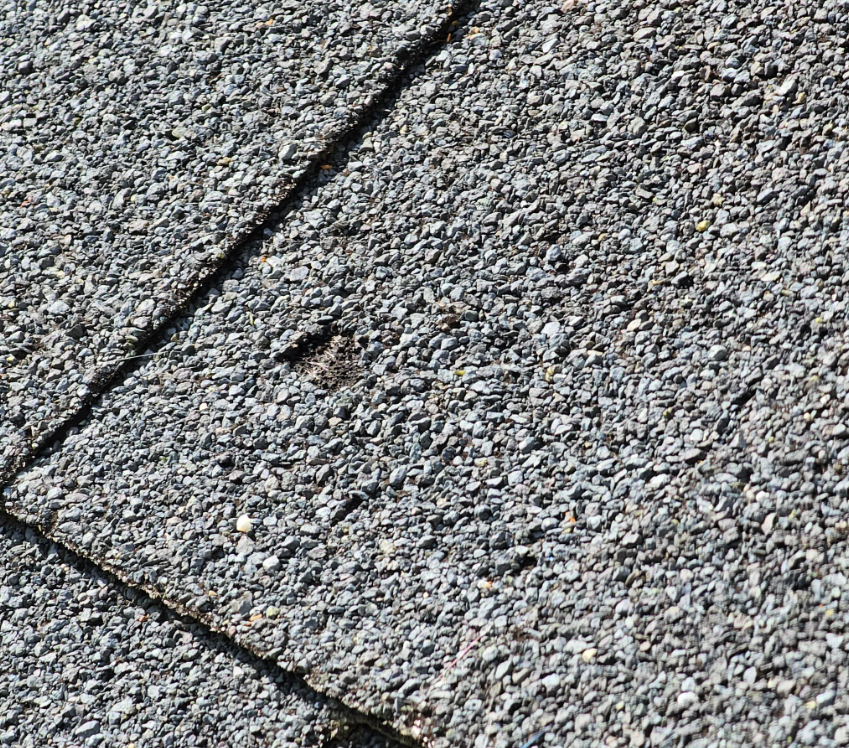
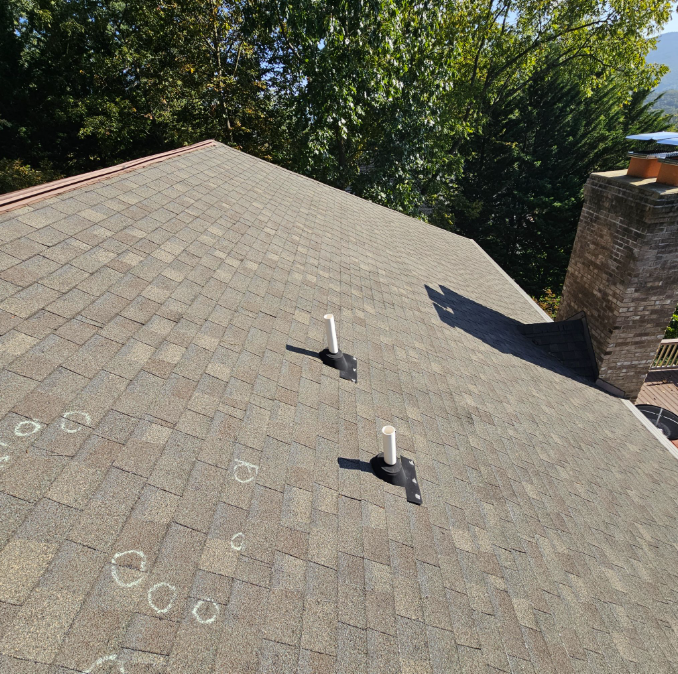
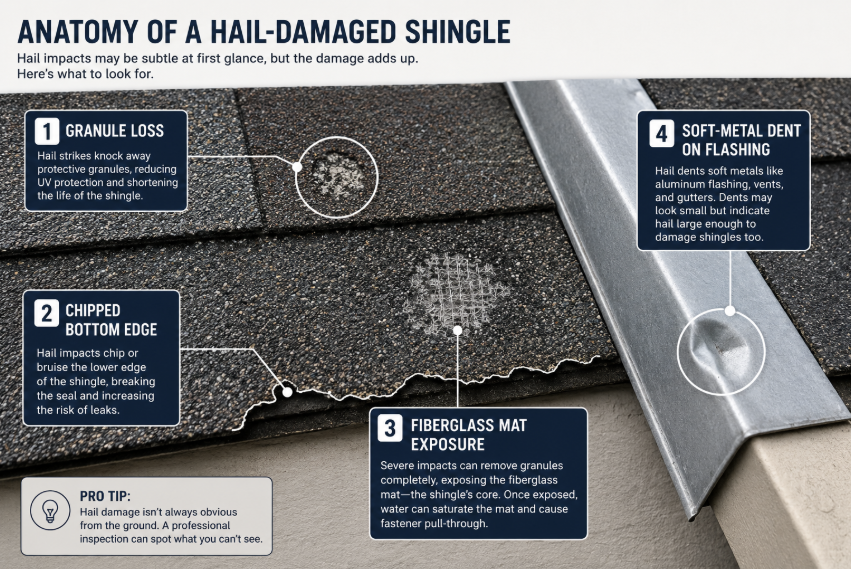
- On-roof and interior documentation. We look for the impacts an untrained eye and even some adjusters miss: the chipped bottom edges of asphalt shingles, the distinctive patterns hail leaves on soft metal (pictured below), the chimney flashing pocked on one side and clean on the other depending on which way the wind drove the storm.
- Written damage report. Whether you hire us or not, the report is yours.
- Insurance coordination. We meet your adjuster on the roof so nothing gets missed.
- Material selection. Owens Corning and GAF are certified, with impact-rated shingle options that may carry an insurance discount. See our roofing services for details.
- In-house crew dispatch. Our crews are not here temporarily and gone tomorrow.
- Final inspection and warranty registration. We are still here a year later when you call.
How Do You Tell a Legitimate Storm Contractor From a Storm Chaser?
After every major storm, out-of-state crews fly canvassers into the Valley. They knock on every door on every street and try to manufacture a claim. The National Roofing Contractors Association and the National Insurance Crime Bureau have documented cases of predatory roofers causing additional damage to roofs to fake hail. We have heard the same story from local adjusters. This is not a faraway problem.
Look for a Virginia Class A contractor with a real local address you can drive to, a license number you can verify on the Virginia DPOR lookup, and a manufacturer certification you can confirm directly with the manufacturer.
Here are the questions to ask and the answers to expect:
| Question to Ask | Good Answer | Walk-Away Answer |
|---|---|---|
| “Where is your shop?” | A specific Shenandoah Valley address | “We are mobile” |
| “What is your Virginia Class A license number?” | A number you can verify in seconds | “Our office handles that” |
| “What about my deductible?” | “You pay it. That is the law.” | “We will waive it” (this is fraud) |
| “Who handles warranty calls next year?” | “Our service team, in-house” | Silence |
What Should You Expect From Your Insurance Company?
In plain terms, an ACV (actual cash value) policy pays the depreciated value of your roof, while an RCV (replacement cost value) policy pays to replace it with one of like kind and quality. Most Valley homeowners we work with carry RCV, but you should pull your declarations page and confirm before the adjuster ever sets foot on the property. If the policy says ACV, the math at the kitchen table is going to look very different, and it is better to know that on day one than on day forty.
How depreciation actually works. RCV does not arrive in one check. The carrier first pays you the actual cash value, the replacement cost minus depreciation based on the age and condition of the roof. Once the work is complete and we send proof to the insurance company, they release the held-back amount, called recoverable depreciation. On a $24,000 roof with $9,000 of depreciation and a $2,500 deductible, your first check might run around $12,500 and the second around $9,000. Where homeowners get burned is signing with a discount contractor who charges less than the RCV figure. The carrier will only release depreciation up to what you actually spent. The rest stays with the insurance company, not in your pocket.
Deductibles, in plain English. Your deductible is the amount you pay out of pocket before the insurance company pays anything. In Virginia, many policies now carry a separate wind and hail deductible calculated as a percentage of your dwelling coverage rather than a flat dollar amount. On a home insured at $400,000 with a 2 percent wind and hail deductible, you are looking at $8,000 out of pocket on a storm claim, not the $1,000 you may be used to from your “all other perils” deductible. Pull your declarations page and look for that line specifically. We have walked too many homeowners through this number on the kitchen table after the fact. And to repeat what we said earlier, any Virginia contractor who offers to “eat” or “waive” your deductible is asking you to commit insurance fraud. Walk away.
What you should document. Your adjuster is going to be on your roof for 20 to 40 minutes, then juggling another 30 claims that week. The homeowners who get a fair scope are the ones with paper. Keep a folder, digital or otherwise, with time-stamped photos and video taken before any cleanup or tarping, a copy of your declarations page and the full policy, your claim number, your adjuster’s name and direct line, every receipt for temporary mitigation (tarps, plywood, even the hotel night if your home was uninhabitable), a dated log of every call and what was promised on it, and the contractor’s written estimate and damage report.
Common delays, and what causes them. The biggest one is volume. After a regional hail or wind event, a carrier may be juggling thousands of new claims at once, and an adjuster who would normally inspect within a week may not get to you for three. A second is the supplement process. The first scope almost always misses items, drip edge, ice and water shield, code-required decking nails, satellite dish reset, and the carrier needs photos and code references to approve each one. A third is the mortgage company. If your loan is not paid off, your insurance check is going to be made payable to both you and the lender, and the lender’s loss draft department will inspect it at milestones before releasing funds. None of this is hostility on anyone’s part. It is a process, and a contractor who has been through it knows which person at the carrier to call.
The realistic timeline. In Virginia, a clean, single-trade claim with an attentive adjuster usually runs four to eight weeks from filing to final check. Add a supplement and you are looking at six to ten. Add a mortgage company holding funds in loss draft, and you are looking at eight to twelve. We have closed claims in three weeks and we have closed claims in seven months. The difference is rarely the homeowner. It is documentation, follow-up, and knowing which lever to pull next.
What Should You Remember When the Next Storm Hits?
Storm season in the Valley is not coming. It is here. Homeowners who handle the first 72 hours well are the ones who get a clean repair and a clean check.
-
- If you see shingle granules piled at the base of your downspout, then you likely have hail bruising even if the roof looks fine from the driveway.
- If a contractor offers to waive your deductible, then you are looking at fraud, not a deal.
- If your home was built before 1980, then your decking may need attention that the adjuster will not flag without a real contractor on the roof.
- If a stranger knocks the day after a storm, then your local roofer is almost always the better call.
See what a finished Valley Roofing storm restoration actually looks like in our project gallery. When you are ready, book a free discovery call, and we will walk your roof, hand you the report, and let you decide what to do next. No pressure. No door knocking.